Saturday, October 9, 2010

Palladium Climbs to Highest Price Since 2001 on Increased Investor Demand


By Claudia Carpenter and Sungwoo Park:

Palladium rose to a nine-year high in London and New York on speculation that reduced currency values and steps to revive growth will accelerate demand for the metal.

ETF Securities Ltd.'s ETFS Palladium Trust, started in January, has bought 44,437 ounces of the metal in the past three days, according to information on the company's website. That's 7 percent of global investment demand for all of last year, based on Johnson Matthey Plc estimates. Palladium is also needed by car manufacturers to make catalytic converters.

"Palladium is in demand because of a recovery in industrial demand and as a store of value for investors," said Daniel Briesemann, an analyst at Commerzbank AG in Frankfurt. "Not only gold and silver are profiting from investment demand but also platinum and palladium."

Palladium for immediate delivery rose as much as $16.50, or 2.8 percent, to $602.75 an ounce, the highest since June 27, 2001, and was up 2.7 percent at $602 an ounce at 12:20 p.m. in London. Palladium for December delivery advanced 2.8 percent to $606.25 an ounce on the New York Mercantile Exchange, the highest price for a most-active contract since June 28, 2001.

Palladium has climbed 48 percent this year, more than double the gain in platinum and exceeding advances in gold and silver.

Palladium may rise to $700 an ounce over the next six to 12 months, Colin Fenton and Matthew Lehmann, analysts at New York- based JPMorgan Chase & Co., wrote in a report dated yesterday. There is "solid emerging-markets' physical demand for the auto sector," they wrote in the report.

Palladium is viewed as "the most likely" of the three major platinum-group metals, including platinum and rhodium, to return to deficit, Morgan Stanley said in a report on Oct. 5.

Russia may have exhausted state inventories of the metal, Norilsk Nickel said in May. Sales from state stockpiles reached 960,000 ounces last year, the third-biggest contributor to world supply after mine output from South Africa and Russia, according to Johnson Matthey.

An Electronic Run on the Banks - The Second 911

In late 2008 Democrat Congressman Paul Kanjorski accidentally lifted the curtain that normally hides the Wizards of Oz in the Federal Reserve and US Treasury. Go to the 2 min point in the video, he says that he was there when the Security of the Treasury (Hank Paulson) and the Fed Chairman (Ben Shalom Bernanke) on the Sep 15th (Mon 15th Sep 2008) went to members of Congress to explain what was going on. He says “here's the facts, and we don't even talk about these things, on Thursday at about 11 o'clock (looking back at the 2008 calendar the Thursday was 11th September)

A summary of what he goes onto to say is:

"The Federal Reserve noticed a tremendous draw down of money market accounts in the USA to the tune of $550 Billion dollars in a matter of an hour or two.

Money was being removed electronically.

The treasury tried to help with $105 Billion.

But could not stem the tide.

It was an electronic run on the banks

The treasury intervened but had they not closed down the accounts they estimated that by 2 PM that afternoon. Within 3 hours. $5.5 Trillion would have been withdrawn and collapsed and within 24 hours the world economy."

Subsequently on the 19th of September Hank Paulson announced publicly that he needed $700 billion to save the banking system from collapse. When his plan was met with public outrage and general congress revolt Hank Paulson had a closed door meeting with Congress after which most members of Congress voted for the Paulson plan. It has subsequently been reveled, from several sources, that Hank Paulson threatened the imposition of Martial Law if his bank bailout plan was not passed immediately.

Subprime flowchart

Very Strong Momentum In Silver Drives Prices To A 30-Year High


David Levenstein
7 October 2010
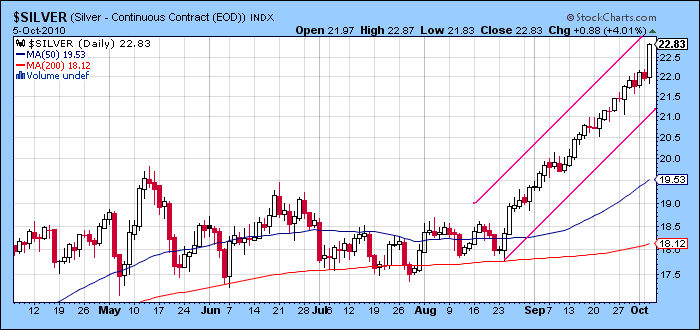
In the same time that the price of gold has moved from its recent lows of $1155 to a new record high, a hair below $13500 an ounce; an increase of 17%, the price of silver has moved from $17.50 to $23; an increase of 31%!

In The Delaire Report issue number 24, I clearly stated that "we will see the price of silver make a decisive break above $18.50/oz and a rapid move to $21/oz. Thereafter, it should challenge the $25/oz level. It is also my firm belief that silver is going to be one of best performing assets during the next five years."

During the last six weeks the performance of silver has been exceptionally stellar and to be frank, it has surpassed my expectations. By that I mean the price has got to a level in a shorter time frame than I expected. But, the price level does not surprise me, nor does the percentage move. On many occasions I have written about the percentage moves in silver and how they are generally much greater than those in gold.

Like gold silver is effected by the global currency crisis and as the dollar continues to weaken, silver prices will continue to increase. As the price of silver trades at a 30 year high and as the price has increased by 31% in less than six weeks, everyone is asking if there is going to be a correction. Well, of course there will be a correction, but I am not sure if we will see it occur at these levels or if we will see it once the price of silver hits $25. But, as long-term investor who cares? I am not in the business of trying to time every move in the market and believe that it is impossible to do that. However, the longer term bullish trend is very much intact and the price has a long way to go before it peaks. As the price of gold gets more expensive some investors may prefer silver to gold because it is less expensive and because it is still very much undervalued.

"Wealth preservation are the key words… We expect silver to keep trading in parallel or stronger than gold, but with higher volatility as recovering industrial demand and even stronger investor demand gives the metal an extra boost," stated Filip Petersson of SEB Commodity Research in an article in The Wall Street Journal.

On Tuesday, holdings in global silver exchange-traded products rose by 103 metric tons to set a record of 13,867, reports Barclays Capital. In India, the world's largest importer of gold, there is a growing sentiment that silver is replacing the yellow metal. For the first half of 2010, silver imports in India have risen 579 percent, for a total of $1.69 billion. Many analysts see the momentum in India rising through the festival/holiday buying season.

Last week the United States Mint raised their wholesale pricing above spot on American Silver Eagles to all authorized dealers from $1.50 to $2.00, an increase of a whopping 33%. This year will go down as a record year for Silver Eagle sales, as the United States Mint has already sold more than 25 million coins year-to-date.

The forecast for silver is overwhelmingly positive, and I still urge investors to buy some of the physical metal. Buy bullion bars and bullion coins no matter the premiums. In a few years time the prices that you pay now are going to look very cheap in comparison to prices you are going to have to pay in the future.

TECHNICAL ANALYSIS

The recent move in silver has been very strong as evidenced by the number of bullish candlesticks. A market with such momentum seldom collapses overnight. It is possible for the price of silver to move higher before we see a correction and some consolidation.

Weekend Chill Out

This weekend's chill out is dedicated to the soldiers in The War on Paper
the music video can be seen here or play the live versions below


Friday, October 8, 2010

Gold Price Chart


~ thanks to Jesse for the chart

Vietnam Plan Would Allow Gold Imports


From the Wall St Journal:

By VU TRONG KHANH

HANOI—Vietnam's central bank said Thursday that it might allow local companies to import gold in order to stabilize the local gold market, after domestic prices rose to a record this week.

Gold is a popular investment in Vietnam, where a long period of strong consumer-price inflation and several devaluations in the Vietnamese dong have undermined confidence in the local currency.

Allowing gold imports could temper the domestic price of the precious metal, which has risen above global prices. But it could also push up the Southeast Asian country's total import bill, worsening a persistent trade deficit that has hurt the dong.

"Enterprises may be allowed to import gold in appropriate quantities and at appropriate times to stabilize the domestic market," Nguyen Quang Huy, head of foreign-exchange management at the State Bank of Vietnam, said in a statement on the bank's website.

Gold prices in Vietnam have exceeded world prices at times recently, as local investors place big bets on further increases in the global price, Mr. Huy said.

Gold reached a record of 33 million dong ($1,693) per tael Wednesday, about $1,405 a troy ounce. The spot gold price hit $1,349.80 per ounce Wednesday in Asia, a record. In the U.S., the most actively traded gold contract, for December delivery, settled at a record $1,347.70 a troy ounce Wednesday on the Comex division of the New York Mercantile Exchange. Thursday morning it was at $1,347.50 an ounce.

Under the proposed plan, Vietnamese companies wanting to import gold would need to obtain licenses from the government.

"Importing gold in appropriate quantities is the best option for now, though it may have collateral effects," said Le Tham Duong, an economist with the Banking University of Ho Chi Minh City.

He said that by stabilizing local prices, gold imports would help prevent speculation and gold smuggling from foreign countries.

"If speculation happens, it will be very bad for the economy as the capital will rest in gold, instead of being invested in production," he said.

He added that illicit gold imports would lead to outflows of dollars, potentially adding to downward pressure on the dong.

The dong has fallen more than 5% since January as the country's trade deficit has widened, and was trading around 19,498 dong per dollar Thursday.

Vietnam's trade deficit widened to $8.56 billion in the January-September period from $6.8 billion a year earlier, according to official data.

Gold is one of the four major investment options for Vietnamese citizens, besides stocks, real estate and U.S. dollars.

The Gold Symposium

8th - 10th November 2010
Sydney, Australia


s
The Gold Symposium being held at the Amora Jamison Hotel in Sydney, Australia.

In association with ABC Bullion.

Learn how high gold could go in Australian dollar terms?

When will we reach a top... and what will it be?

If gold really is to become the foundation of a new financial order... what will that mean for society and your investments?

What if this really is a bandwagon, and you’re the last to jump on? Gold stocks tend to lag behind the price. So if you’re still a gold bug, which Australian stocks could be the stand-outs in 2011?

DAY ONE: Monday 8th November
Showcasing ASX listed companies whose focus is on gold exploration and production. This is a perfect opportunity to invest in companies whose focus is on gold exploration and production

Day One of the Symposium is designed to promote Australian GOLD companies to a wide variety of investors: from professional brokers, analysts and private investors who are current shareholders, to others who are keen to understand more about these companies whose focus is GOLD.


DAY TWO & THREE: Tuesday 9th and Wednesday 10th November
Featuring highly respected speakers from Canada, Australia and the USA, this event is set to be a sell out event and not to be missed.

Hear speakers such as Dan Denning of the Daily Reckoning and Dr David Evans of Gold Nerds along with other incredible speakers

Don’t miss the world renowned James Dines - one of the most famous gold bugs on the planet—when bullion is breaking records daily. This will be his first time speaking in Sydney si
nce his sell out speaking tour at the Opera House and one not to be missed

Moneyline called Mr Dines "one of the most extraordinary men in America today; a man with a long and glorious reputation in being one of the first people to call the real turns in the strategic moves that happened in our marketplaces over the years."


If you’re familiar with his writings—and his take on gold—you’ll realise the timing couldn’t be better to hear what he’s thinking right now

Program

To download a copy of program please click here

DAY ONE: MONDAY 8TH NOVEMBER 2010
The program for day one is currently being compiled. Please come back soon for an updated program.

DAY TWO: TUESDAY 9TH NOVEMBER 2010
7.30am
REGISTRATION and WELCOME COFFEE
8.30am
Welcome Address – Dr Marcus Matthews, Chair, The Gold Symposium and Kerry Stevenson, Managing Director, Symposium

8.40am
Mr Brett Le Brocque, Australian Bullion Company, Sydney, Australia
A fast track lesson on gold and silvers past, present and a blueprint looking forward - part 1
• How the goldsmiths became the modern day bankers and the start of Fractional Reserve banking.
• History’s examples of Currency vs. Money
• Why Gold has been the best performing asset class in the last 9 years yet hardly anyone owns it and why you need to own it now!
• Where are we now in the cycle and what’s still to come


9.40am
Mr Dan Denning, Editor, The Daily Reckoning, Melbourne, Australia
The Welfare State we're in
• In Western democracies, paper money has allowed the Welfare State to grow very large - too large
• Sovereign bankruptcy means the 'welfare' part of the Welfare State is going to shrink
• Sound money is suddenly on the agenda again as gold is r
emonetised in response to the debt crisis
• If gold is a foundation in a new financial order, the implications for society are profound


10.20am
Mr Louis Boulanger, CFA, Founder and Director, LB Now Ltd, Auckland, New Zealand
The origins of money and its nature today
• What is money? How did it come about?
• Why do most people, including mainstream economists, know so little about it?
• We look at the true origins and nature of money
• What now passes for, and is accepted as, money?
• Who decides what money is today?


11.00am
MORNING TEA
11.30am
Dr David Evans, mathematician and founder of GoldNerds, Perth, Australia
How our full fiat paper money system works and fails
• How money is manufactured in today's monetary system
• Each dollar spent in stimulus eventually reduces GDP by $3.40 when it has to be paid back. But in today's fiat system, it doesn't really have to be paid back
• The unprecedented debt bubble of the last 30 years is ending; what comes next?
• Gold is returning to the monetary system, back by popular demand

12.15pm Mr Robert Lambourne, Chairman, Penox SA, United Kingdom
Gold, interest rates, and Gibson's Paradox
• Gibson's Paradox was the observation that the rate of interest and the general level of prices were observed to be correlated, first reported in 1923
• It was considered a paradox because economic theory postulated that the rate of interest would be correlated with the rate of change in the general level of prices
• Professors Barsky and Summers in a paper published in 1988 linked the paradox to the operation of the gold standard
• Commentators consider that this paper resulted in a covert policy of gold price suppression aimed to reduce long-term interest rates
(Lawrence Summers is President Obama’s principal economic adviser)


1.00pm LUNCH
2.00pm Mr Laurie McGuirk, Chief Executive Officer, AgAu Capital
TBC


2.40pm Mr Rudy Fritsch, President, Allsteel, Toronto, Canada
Outline of an alternative monetary system
• Based on positive values (gold) not negative values (debt)
• No ‘fiduciary’ or trust-based component to money (i.e. no unbacked bank notes in circulation)
• The huge stock-to-flows ratio of gold assures steady value of the monetary numeraire
• A fixed money supply implies the need for a flexible clearing system to accommodate variations in commercial demand; Real Bills in worldwide circulation provide this flexibility
• Bank portfolios to consist of ~1/3 cash Gold, ~2/3 Real Bills as earning assets


3.30pm AFTERNOON TEA
4.00pm Dr Marcus Matthews
Where to from here


4.30pm Panel Discussion
Chair: Dr Marcus Matthews

• Dr David Evans - Mathematician and founder of GoldNerds
• Mr Rudy Fritsch - President, Allsteel
• Mr Louis Boulanger - Founder and Director of 20
• Mr Brett Le Brocque - Australian Bullion Company

5.30pm CONFERENCE DRINKS

DAY THREE: WEDNESDAY 10TH NOVEMBER 2010
8.00am WELCOME COFFEE
8.30am Welcome Address – Dr Marcus Matthews, Chair, The Gold Symposium and Kerry Stevenson, Managing Director, Symposium

8.40am Mr Brett Le Brocque, Australian Bullion Company, Sydney, Australia
A fast track lesson on gold and silvers past, present and a blueprint looking forward - part 2
• How the goldsmiths became the modern day bankers and the start of Fractional Reserve banking.
• History’s examples of Currency vs. Money
• Why Gold has been the best performing asset class in the last 9 years yet hardly anyone owns it and why you need to own it now!
• Where are we now in the cycle and what’s still to come


9.40am Mr Richard Karn, Managing Editor, The Emerging Trends Report, Anchorage, USA
ZIRP means you cannot not speculate
• When the inflationary rubber meets the real-world road, it always shows up in commodity prices. The market is aware of gold, silver, and oil but less aware of the 'enabling' technology metals'
• When widespread computer processing speed and advances in modelling software is applied to material science and metallurgy, technological innovation blooms
• Why the enabling metals are irreplaceable and secure sources of them will command high premiums
• Of the 45 metals identified as being under some form of supply threat, as many as 38 may be produced in Australia within the next 18 months, notwithstanding the efforts of the government
• We are touring Australia in search of listed companies positioned to meet this demand for precious and specialty metal
s
ZIRP = Zero interest rate policy
10.10am Mr Gavin Thomas, Managing Director and CEO, Kingsgate Consolidated
Gold – from start to finish
Gavin has found and developed gold projects in far flung locations and will discuss:
• Why is gold exploration an expensive process with few discoveries becoming economic?
• What are some of the methods and approaches used in exploration?
• Why does it take so long to get discoveries into production and why is the process so unpredictable?
• What are the key methods used in mining gold and extracting/processing gold?
• Where is the future for gold exploration and mining?


10.40am MORNING TEA
11.10am Mr Barry Dawes, Managing Director, Martin Place Securities, Sydney, Australia
Opportunities for the private investor
• We are in a secular bull market for commodities
• This is occurring against a backdrop of gold reasserting its monetary role
• Investors owning profitable commodity-producing companies will do well, while those holding currencies and paper assets will not
• What resource companies should you be looking to own?


12.00pm Prof Steve Keen, Associate Professor of Economics and Finance at the University of Western Sydney, Australia
Too much debt and too little time to debunk it
How credit money works and why it normally malfunctions
• Why this crisis has been caused by the bursting of a debt-financed speculative bubble in financial assets
• Courtesy of the US Federal Reserve rescuing the financial system from its own follies, the level of debt accumulated this time dwarfs that before the Great Depression
• The only way out is the abolition of debt that should never have been extended in the first place


1.00pm LUNCH
2.00pm Mr James Dines, Investment Analyst, San Francisco, USA
Mr Dines is one of the most accurate and highly regarded investment analysts today.
They laughed when Mr Dines recommended gold at $35 and he became “The Original Goldbug,” but nobody is laughing at $1,200. What are some profitable
opportunities next? Why does America have a monopoly on printing its reserve currency without limit?
• Even now many do not believe Mr Dines’ longstanding prediction of “The Coming Great Deflation” internationally, but what’s next? Boom or Bust, inflation or deflation, or even a hyperinflation?
• Mr Dines became “The Original Rare Earth Bug” in his 22 May 2009 Dines Letter, and they subsequently rose greatly, but which ones are the best buys right now?
What about the outlook for uranium and global warming causing raging wildfires and floods? Also, other base metals, especially titanium.
• Mr Dines is a founder of the field of Technical Analysis, and will display spectacular charts from his personal chart library, with trendlines pointing to likely targets, so don’t miss this highlight


4.00pm AFTERNOON TEA
4.30pm Panel Discussion
Chair: Dr Marcus Matthews

• Prof Steve Keen - Associate Professor of Economics and Finance, University of Western Sydney
• Mr Barry Dawes - Managing Director, Martin Place Securities
• Mr Richard Karn - Managing Editor, The Emerging Trends Report
• Mr Brett Le Brocque - Australian Bullion Company


5.30pm EVENT ENDS

Registration

Download registration form

Program

Presenters

Venue

The Golden Gift – A Modern Solution to an Unsound Global Monetary System Gold & Silver: This Time it IS Different


From SmartknowledgeU:

With gold and silver bulls, since the beginning of this new PM bull in 2001, the four dreaded words that every gold/silver bull has been reluctant to say because it has served as the kiss of death every time gold/silver has been on the verge of a seemingly enormous breakout, is “This time is different.”

Yet this time IS different and here’s why. At the rate of currency devaluation being inflicted upon the world’s major currencies today by Central Bankers there are, and there will be, no real gains in any of the world’s leading stock markets. As every gold bull reader is aware of, if you price the world’s leading stock markets in gold, all Western government/banker engineered rises in stock markets are exposed for what they are – illusory gains, not real gains. Real gains for the last two months in most Western stock markets when priced in gold are firmly negative. The rigged rises in Western stock markets have been nothing more than shenanigans designed to fool the people into buying the economic recovery fable that bankers/politicians so desperately are attempting to sell, especially in the US, where November mid-term elections loom. For example, price the S&P 500 index in gold since early August, and one will discover that the S&P 500 has dropped more than 9.3%. Price the S&P 500 in silver and the losses are even more marked, at nearly 20%.

While is true that gold/silver are heavily overbought now and PM stocks are either in heavily overbought territory or rapidly approaching heavily overbought territory, during strong runs in past gold/silver bulls, the underlying metal prices and stock prices can remain in overbought territory for months on end. This alone is not a reason for a correction as Central Bankers have been fighting the fundamental weaknesses in their fraudulent global monetary system daily for quite some time now. When bankers legalize fraud through the legislation they sponsor/endorse, technical analysis is insufficient to ascertain the short-term direction of not only stock markets but also gold/silver markets. One must understand the history of Central Banker engineered attacks and price suppression schemes against gold and silver to estimate the probabilities of short-term corrections in addition to the use of technical analysis.

Today, Central Bankers are increasingly having a more and more difficult time suppressing the price of gold and silver. This is a marked departure from years past, even as recently as 2008, when they engineered a gold/silver crash to coincide with their engineered stock market crash. Though they still have the power to engineer short-term corrections in gold/silver markets, their power to do so has been fading this past year. They must resort to more and more trickery to engineer these collapses. If they decide to engineer a strong rapid decline in major US indexes in the near future, you can be sure that they will use this event to also use all of their abilities to engineer a simultaneous sell-off in gold and silver. Still, any correction we receive in gold/silver markets before the end of the year will be likely to be very short-lived as various global players will step in, stop the decline with buying, and continue the rising trend in gold/silver prices. In any event, the fading influence of the Bank of England and the US Federal Reserve over gold/silver markets has happened for a number of reasons.

Western Central Banks, specifically the US Federal Reserve, very likely possess much less gold than their “official numbers” indicate. Though the US Federal Reserve only owns paper certificates, these gold certificates give them ownership of the gold reserves at Fort Knox. The Fed’s price suppression schemes against gold and silver over the past several decades have involved leasing gold to bullion banks, who then sold the bullion into the market. Much of this gold has never been returned to the official US gold reserves. During periods when the Fed was known to be leasing gold via the cooperation of bullion banks, the reported US gold reserve numbers never changed, revealing the official numbers to be a total fraud. This, among numerous other instances of verifiable and exposed lies regarding the Federal Reserve statements regarding their official gold reserve figure, is why I am quite confident that the Fed currently owns much less physical gold than they claim. Selling physical gold into the market through leased gold to bullion banks was one of the most important mechanisms that the Fed used to suppress the price of gold and silver. With the efficacy of this mechanism largely gone as well as the desire of Central Bankers to sell gold almost non-existent, supply/demand dynamics for physical gold and silver are extremely different than they were just a mere five years ago. For a comprehensive list of acknowledged and proven US Federal Reserve gold price suppression schemes, visit this very well-researched GATA article, linked here, titled “Gold Price Suppression is Public Record and Public Policy, Not Conspiracy Theory”.........read on

George Soros and Jim Rogers warn on financial markets


From ArabianMoney.net:

Two old hedge fund partners who have long since gone their separate ways as billionaire investors, the legendary George Soros and Jim Rogers are buying commodities because they reckon stocks, bonds and real estate are not the place to be invested in current markets.

Jim Rogers commented this week: ‘Whether the world gets better or does not get better, commodities are going to do well. If the world economy does not get better, stocks are going to fall apart. We have a bubble forming in bonds. Bonds are selling at much higher price and that bubble is going to burst some day. So if I would do any defensive buying, I would start in the commodities market, not the stock market.’

Hot Commodities

The author of ‘Hot Commodities’ (click here) Jim Rogers first bet on the start of a secular bull market in commodities back in 1998. And as The Daily Reckoning points out today the index he developed at the time is up 15.5 per cent since early July.

Meantime, his old partner George Soros who is believed to be one of the models for the fictional Gordon Gekko and has approximately $25 billion under management , has recently slashed his US equity investments by 42 per cent to $5.1 billion. But actually it is the situation in Europe that troubles him most.

In remarks prepared for a speech to Columbia University today, Soros will say: ‘Deficit reduction by a creditor country such as Germany is in direct contradiction of the lessons learned from the Great Depression of the 1930s, and will set in motion a deflationary spiral in debtor countries. It is liable to push Europe into a period of prolonged stagnation or worse.’

German depression

Recent press comment has focused on record GDP growth in Germany but total GDP is still running at seven per cent below pre-crsis levels. This has produced the illusion of a recovery that has not actually happened.

Soros warns: ‘Under duress, the euro has begun to remedy its main shortcoming, the lack of a common treasury. But it is far too early to celebrate because the emerging common fiscal policy is dictated by Germany and Germany is wedded to a false doctrine of macro-economic stability, which recognizes only the threat of inflation and ignores the possibility of deflation.’

The man who broke the Bank of England in 1993 has also become a gold bug doubling his gold holdings (click here) while his former business partner Jim Rogers reckons silver offers even more upside (click here). Looking at the price of gold and silver this morning these old guys are still ahead of the game.