Thursday, October 14, 2010

Gold: Another Record High at $1,374


From the UK Telegraph:

The price of gold rocketed to another record high on Wednesday, powered by the weakening dollar after the US Federal Reserve signalled that it would consider more pump-priming stimulus measures.

The precious metal hit $1,374.35 an ounce at about 4pm on the London Bullion Market.

"Once again gold dominates the headlines, with yet another new record high," said Rajesh Patel, head trader at trading firm Spread Co in London.

"The catalyst this time? The minutes from the 21st September FOMC [US Federal Open Market Committee] released yesterday gave a pretty clear indication, not that it was a surprise to anyone really, that a resumption of QE [quantitative easing] is 'appropriate before long'."

In foreign exchange deals on Wednesday, the European single currency topped $1.40 as the US currency came under pressure from the prospect of further monetary easing.

A faltering greenback makes dollar-denominated gold cheaper for buyers holding stronger currencies, pushing up demand for the metal and eventually its price.

Minutes from last month's FOMC meeting had showed that the US Federal Reserve anticipated that additional stimulus might be needed soon to prop up a slowing economic recovery.

"Such an indication accorded with the members' sense that such accommodation may be appropriate before long, but also made clear that any decisions would depend upon future information about the economic situation and outlook," the minutes read.

That signal fired up expectations the Fed would soon pump money again into the economy through major asset purchases, a measure known as quantitative easing.

BIS Taking in More Gold - who are the counterparties this time?


From Mineweb.com, by Rhona O'Connell:

The latest figures from the IMF show that the Bank for International Settlements' declared gold holdings are on the increase again. The BIS hit the headlines earlier this year when analyst Matthew Turner spotted figures in the BIS' Annual Report that showed the Bank's holdings of gold had soared as the Bank had carried out swaps with what turned out to be commercial counterparties (the initial interpretation was that it had come from other central banks). By the end of April, the BIS' net gold holdings stood at 468 tonnes, having been just 119 tonnes as recently as the end of November.

The BIS' gold holdings were more or less unchanged over the next three months, but they have been increasing again since June, rising from approximately 467t to 512t over the months to end-August, an increase of 45t.

As shown in the chart below, the nominal value of the gold at the end of August stood at almost $21 Bn, more than five times as much as at the end of October 2009, reflecting a four-fold increase in the tonnage held, allied to a 20% increase in the gold price.

On a very approximate basis, taking the monthly average price against the change in tonnage reported for the BIS shows the following monthly dollar increments (in $M):

Nov-2009

Dec-2009

Jan- 2010

Feb-2010

Mar-2010

Apr-2010

May-2010

Jun-2010

Jul-2010

Aug-2010

-33

1,249

5,999

3,036

1,908

92

-31

854

192

739

So while the most recent three months increases, totalling $1.8Bn, don't compare with the $12.2Bn of Dec-March inclusive, they nonetheless suggest that the BIS remains on the alert and is taking gold as collateral accordingly. Last time, the press reported that the counterparty banks included HSBC, Société Générale and BNP Paribas, swapping gold with the BIS against the dollar-deposits that the former banks were taking from the latter. The latest increases in BIS' gold is likely to represent similar exercises this time, as commercial banks seek to use the gold in their stewardship. (Not allocated metal, though, which is not available to be lent by the bank that holds the gold on the client's behalf).

The tonnage changes have been as follows:

Nov-2009

Dec-2009

Jan- 2010

Feb-2010

Mar-2010

Apr-2010

May-2010

Jun-2010

Jul-2010

Aug-2010

-0.9

35.7

173.0

85.2

53.2

2.4

-0.8

21.4

5.1

18.5

At the time, the reports of the swaps caused a drop in the gold price. Probably a more logical conclusion is that the implied use of gold as a hedge against counterparty risk, or equally the desire on the part of the BIS to optimise the rate of return on its currency holdings, points to the sustained role of gold in the financial system as a non-fiat currency. Not of itself enough to boost the price, but sufficient to sustain gold's role as a portfolio constituent.

Implied gold holdings at the BIS, tonnes, long term

Source: International Financial Statistics

Meanwhile the IMF continues to dispose of the balance of the gold that it has for sale; at the end of August there was just under 75 tonnes of metal remaining for disposal. The latest on-market transactions have been averaging 17.5 tonnes per month, so if this rate of sale continues, or more off-market transactions take place such as the recent ten-tonne sale to Bangladesh, then the IMF programme could easily be complete by the end of this year, leaving the way clear to for the official sector to be a net purchaser of gold over the whole of next year.

Gold Is Far From Topping - It's Just Getting Started


By Toby Conner:

Lately I've been seeing quite a few analysts calling for a top in gold. I have to say these analysts don't really understand what's happening. If they did they would know that far from topping, gold is just getting started.

Just as a preface let me point out that the fundamental driver of this leg up in gold is the same driver that it's been for the entire 10 year bull market; currency debasement. Only now every country in the world is getting in on the race to the bottom. That being said it's the dollar's turn to collapse. The Euro had its spell earlier in the year and now that cancer has infected the world's reserve currency...just like I said it would.

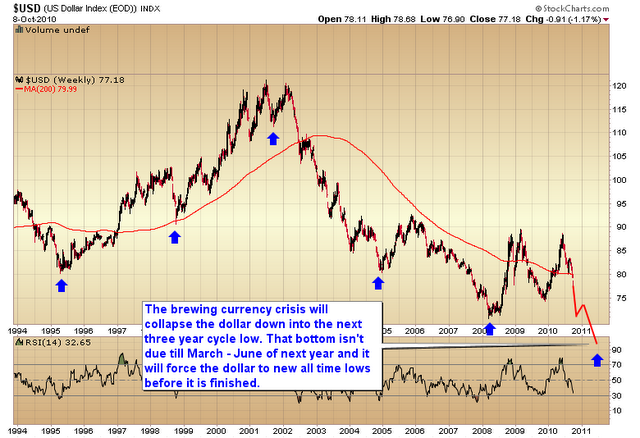
Let me show you a long term chart of the US dollar so you can get a clear picture of what is unfolding.

About every 3 to 3 1/2 years the dollar drops down into a major cycle low. I call it the 3 year cycle low but the average duration is 3 years and 3 months trough to trough. The dollar is now on its way down into that major bottom. After a brief bounce off the `10 lows later this year I expect we will see the dollar roll over early next spring as the final plunge begins and the currency crisis reaches a climax.

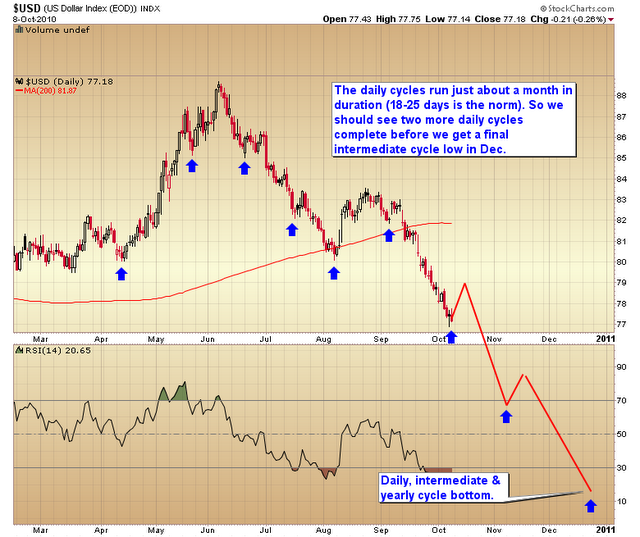
Next let me show you a chart of the smaller daily cycle.

This smaller daily cycle tends to run about a month (18 to 25 days) trough to trough. We are now deep in the timing band for this cycle to bottom. Once it does (it may have on Thursday) we should see a weak rally, possibly back up to test the all important pivot at 80. That should pressure stocks and gold down into their respective cycle lows. I suspect many will take this as a sign that gold's run is over. It won't be.

Gold's drop into the now due cycle low shouldn't last more than 4-8 days. That's about how long we can expect the dollar rally to last as it will only be a dead cat bounce to relieve oversold conditions and ease sentiment extremes. Then the dollar will roll over into another decline that should bottom in early November and will likely test the 74 pivot. Again after another weak rally the dollar will crash down into a daily, intermediate and yearly cycle bottom that should test the `08 lows at 71. That is the point where the gold rally should take a more significant rest.

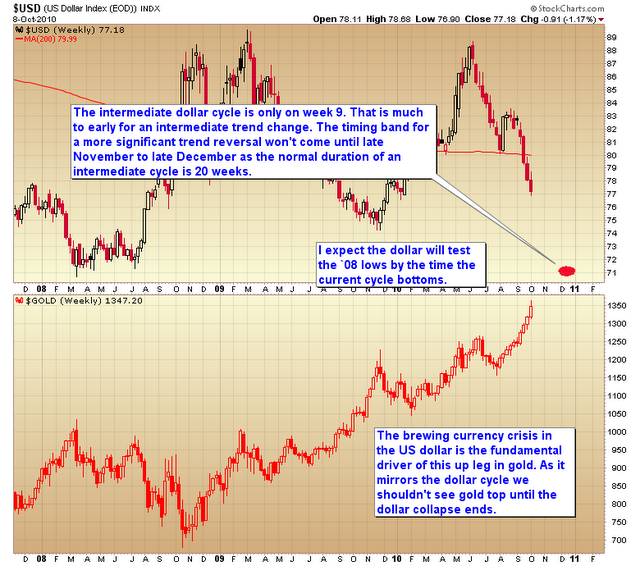
As I noted in the above chart the intermediate dollar, and gold cycle for that matter, runs on average 20 weeks. Last week marked the 9th week of the dollars intermediate cycle. It's way too early to look for a major bottom yet. If the cycle runs the "normal" 20 weeks then we won't get an intermediate bottom until late December. Considering the last yearly cycle low came in early December of `09, mid-December should be a fairly accurate target for an intermediate bottom.

I can assure you that while the dollar crisis intensifies this winter, gold will not be sitting still and it certainly won't be topping. As the dollar crashes down to test the `08 lows I expect we will see gold rocket to at least $1450 and $1550ish is probably a more realistic target.

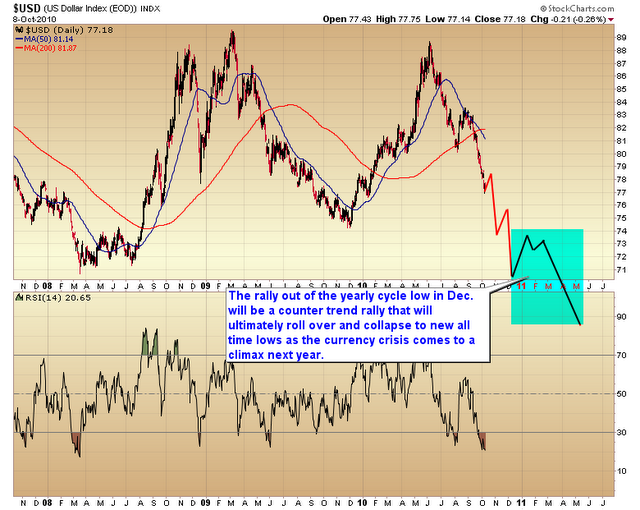
But don't forget the larger three year cycle low isn't due to hit until next spring/summer. The dollar rally out of the yearly cycle low in December will also be a dead cat bounce, although it should last at least a month or two, but ultimately it too will fail and the true consequences of Bernanke's monetary policies will come home to roost as the dollar crashes down into the three year cycle bottom and the currency crisis reaches a climax next year.

That will drive the final leg up in this huge C-wave advance, possibly as high as $1700 -$1800.

So yes gold is due for a minor corrective move but it is a long way from the final topping process of the current C-wave that began in April of last year when the B-wave decline tested 850 which, by the way, was the top of the 1980 bull market.

Folks we are never going to see $850 gold again. And I seriously doubt we will ever see $1200 gold for the remainder of this bull market.

Fed Takes Aim At Chinese Yuan Fuels Commodity & Gold Rally


Gary Dorsch, Editor
Global Money Trends Newsletter

12 October 2010
Although the United States is still the world's #1 economy, it's increasingly feeling the heat of the Chinese dragon, breathing down its neck. At the beginning of the twenty-first century, the US-economy was eight-times larger than China's - a decade later the figure was down to three-times. China's $5-trillion economy has eclipsed Japan, Germany, France and Britain, to become the second-biggest, after three decades of blistering growth, and is now within reach of overtaking the US within 10-years. With China's economic growth rate at 10% and the US-economy struggling at +1.5% growth, - this long-term prediction doesn't sound that far-fetched.

China, with 10-times Japan's population, has long been expected to catch up with its neighbor. But the global crisis and Japan's sluggish growth brought that point forward by many years. China has emerged to become the world's largest exporter, overtaking Germany, which held the title since 2002. Factories employing low-paid workers to assemble iPods, computers, shoes, and toys are leading the boom. China has also passed the US as the world's largest auto market and producer. Two decades ago, a car industry barely existed in China.

In the midst of the global banking crisis, stimulus-driven Chinese growth helped to propel the world's economy out of recession. Chinese demand for raw materials and other imports buoyed economies from Australia to Brazil to South Korea. China uses more than half the world's iron ore and more than 40% of its steel, aluminum, and coal, lifting commodity prices. China is the biggest player in the copper market, buying 35% of the global supply, and is the second biggest importer of crude oil. State-owned Chinese companies are pouring billions of dollars into base metal mines and oil fields from Canada to Latin America to Iraq.

A free trade agreement between China and South East Asian nations came into effect on January 1st, creating the world's third-largest free trade bloc. The combined population of the trade bloc is 1.9-billion people with a combined GDP of $6-trillion. Already, the ASEAN countries are providing the raw materials and manufacturing parts for assembly hubs operating in China. About 60% of China-ASEAN made goods end up in European, Japanese, and US consumer markets.

China is at the epicenter of the fast growing Asian sphere, with satellites such as South Korea, Hong Kong, Taiwan, India, and Australia, hitching a ride to the Chinese juggernaut. The shift of economic gravity to China didn't happen by chance. Beijing's massive intervention transformed its economy into the world's locomotive. The state-run mouthpiece, the People's Daily newspaper has hailed China's economic superiority over Western-style capitalism, boasting about its authoritarian rulers' ability to make quick decisions and their will to carry them out.
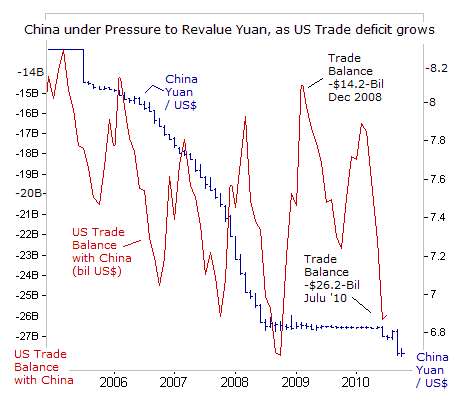
Washington is becoming increasingly alarmed at the rapid rise of China's economic might, and also worries that Beijing might eventually challenge the US for military superiority in the decades ahead. US Congressional lawmakers have long cited Beijing's policy of undervaluing its currency, - the yuan, to give its exporters an unfair advantage in world markets, and making China a more affordable place to attract foreign direct investment in new manufacturing plants. In July and August, the US ran a combined trade deficit of about $52-billion with China, with the massive imbalance highlighting the hollowing out of America's industrial base.

After holding the yuan steady against the US-dollar through the financial crisis, Beijing signaled on July 19th, that it would begin to allow for the yuan to drift higher, but at a gradual pace. Since then, the yuan has gained about +2.2%, - far short of what US lawmakers want. US Treasury chief Timothy Geithner told Congress on Sept 16th, "the pace of appreciation has been too slow and the extent of the yuan's appreciation too limited. We are examining the important question of what mix of tools, those available to the United States and multilateral approaches, might help encourage the Chinese authorities to move more quickly," he warned. IMF economists estimate the yuan is 5-27% undervalued.

As the US-economy continues to stagnate, lifting the all inclusive U-6 jobless rate to 17.1% of the workforce, the Obama administration and Congress are starting to wage an increasingly hostile war against China, demanding that Beijing allow the yuan to rise significantly, and at a faster rate. The US House of Representatives passed a bill on Sept 29th, with huge support of 348-79, that treats China's exchange rate as an unfair subsidy, and allows US companies to request a countervailing tariff to offset China's price advantage. Such legislation, if passed by the Senate, and signed by the President could ignite a full fledged protectionist trade war.
The US-Treasury and the Federal Reserve ("Plunge Protection Team") are seeking to corral central bankers and finance ministers from other G-20 nations, to join Obama's campaign to strong-arm Beijing into raising the value of the yuan more quickly. The US-Treasury is preparing an all-out "currency war," which has already started to inflate commodity and stock market bubbles, by instructing the Federal Reserve to send signals about a resumption of "quantitative easing" (QE-2) or the printing of dollars to purchase US Treasuries notes, in the months ahead.

The Fed is expected to pump vast quantities of freshly printed dollars into the money markets, in a bid to lower long-term Treasury yields lower. The markets have already discounted the probability of at least $500-billion of QE-2 injections. On the surface, the Fed's propaganda artists say they aim to prevent a deflationary collapse and stave off a "double-dip" recession. However, clandestinely, the Fed is monetizing the federal government's debt, and is prepared to buy the Treasury notes that Beijing decides to dump, should a full scale Chinese-US trade war erupt.

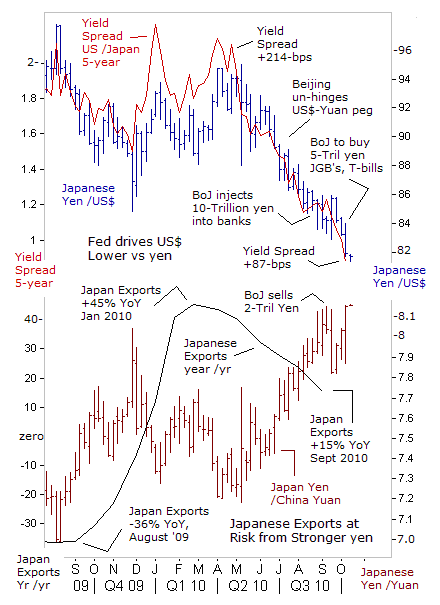
Discounting the probability of QE-2, the US-Treasury's bond yield advantage over comparable Japanese bonds, has narrowed sharply, thus weakening the US-dollar to a 15-year low of 81.75-yen. Tokyo has tried to offset the Fed's QE-2 gambit, saying it plans to launch its own version of QE-3, - a 5-trillion yen ($60-bil) scheme, designed to purchase Japanese government bonds (JGB's) and other securities.

On September 15th, Tokyo acted unilaterally, dumping some 2.1-trillion yen into the foreign currency market, for the first time in six-years, and purchasing of $25-biilion, while trying to defend the US-dollar at 83-yen. However, two-weeks later, the impact of the BoJ's "shock and awe," intervention scheme had worn-off, with the US-dollar sinking to new lows. Japan's counterattacks have failed to reverse the US-dollar's slide against the yen, because the size of the Fed's QE-2 printing spree is expected to be at least ten-times greater magnitude than Tokyo's QE-3.

And because Beijing essentially pegs the yuan to the US-dollar, Japan's exporters are getting slapped with a double whammy, a rising yen versus the US-dollar, and a rising yen versus the Chinese yuan. Since early May, the yen has risen +10% to around 8.2-yuan, making Japanese goods more expensive in China, and also in neighboring Hong Kong, where the central bank pegs the US$ at around HK$7.78.

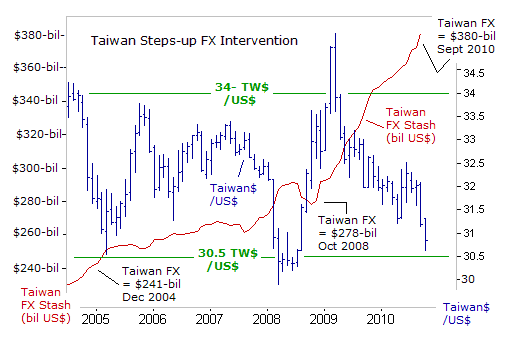
Tokyo's financial warlords are very worried about the yen's strength, since the growth rate of Japan's exports have already slowed by two-thirds, from +45% at the start of this year, to +15% in August. Japan's exports are also becoming less competitive than those from Asian tiger - Taiwan, where the central bank enforces a "dirty float," by restricting the US-dollar to a narrow 10% trading band versus the Taiwan dollar. If left unchecked, the yen's upward spiral against rigged Asian currencies, and the US$, could push Japan's export growth into negative territory by next year.

Taiwan's exports account for roughly 70% of its economic output, and trade data for September showed the growth rate for its exports slowing to +17.5%, down from +26.6% in August. A slowdown in the growth of shipments to the Chinese mainland, where many goods are processed and re-exported, fell from +18.1% in August to +11% in September. All of this suggests Taiwan's authorities will not back down from its efforts to slow the US-dollar's fall, against the Taiwan dollar.

Taiwan's foreign currency reserves jumped $8.4-billion in September, a monthly record, and by about $21-billion in the past 3-½-months. In the first 10-days of October, the Taiwanese central bank bought US$3-billion to prevent it from falling below its red-line in the sand at 30.5-Taiwan dollars, the bottom of a decade long trading range. Through its stealth intervention over the past few years, Taiwan has amassed a huge stash of $380-billion in foreign currency reserves. Yet shockingly, only 4.3% of Taiwan's FX stash is invested in the king of currencies - Gold.

The US Treasury and the Obama team have allowed currency intervention culprits, such as Hong Kong's Monetary Authority (HKMA) and Taiwan, to slip under the radar, and instead, have chosen to focus more exclusively on Beijing's rigging of the yuan. However, the smaller Asian culprits might be next in-line. In any event, Washington is trying to gain the firm backing of the world's second most powerful trading bloc, the Euro-zone, which is also the biggest buyer of Chinese exports, in order to prod Beijing to allow the yuan to rise more rapidly.
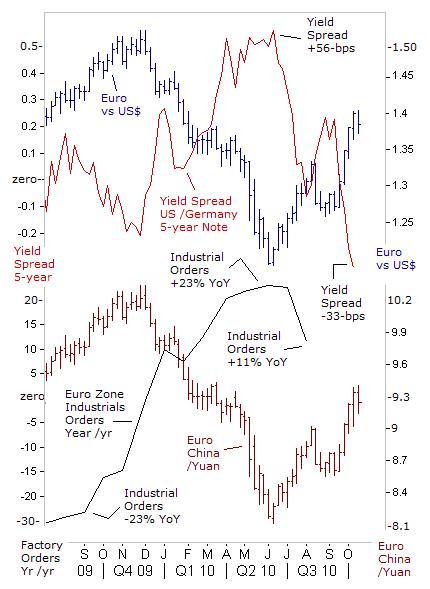
In some ways, the Greek debt crisis was a blessing in disguise for the Euro-zone's economy. The Euro's slide to a four-year low of $1.200, and a nine-year low against the Japanese yen, helped to boost new orders for industrial goods made in the Euro-zone to +23% higher in May than a year earlier. Germany in particular thrived on a weaker Euro, with surging exports and growth in consumer spending, powering the German economy to a record expansion in the second quarter. German exports were bolstered by demand from China and other emerging economies.

The Euro was plunging in a downward spiral in late April and early May, amid fears that the European Central Bank would unleash its own version of QE, by purchasing large quantities of Greek, Irish, and Portuguese bonds that Euro-zone banks were desperately looking to unload. So far however, the ECB has limited its purchases of distressed sovereign bonds to 60-billion Euros, and these purchases were largely sterilized, thus helping the Euro to rebound to $1.400 last week.

Also helping the Euro to rebound sharply versus the US$, was the frequent drumbeat of implied threats by the Fed to unleash QE-2, and public calls of support for the Euro by China's premier Wen Jiaboa. "I have repeatedly expressed China's support for a stable Euro and said that we will not reduce the amount of European bonds that we hold. We have stood by the EU's efforts to overcome its difficulties and achieve recovery," Wen said on Oct 3rd, seeking to curry favor with Euro-zone politicians. Wen also promised that Beijing would buy Greek bonds next year.

However, because Beijing pegs the yuan to the US-dollar, the Euro has climbed about 10% against the Chinese yuan over the past four months, and partly as a result, new orders for Euro-zone industrial goods quickly tapered-off. New orders for industrial goods fell -2.4% in July, slumping to a +11.2% year-on-year rise. Orders for capital goods, which are used in investment, fell -5.1% on the month and demand for durable consumer goods dropped -3.2-percent. Euro-zone exports were +18% higher in July than in the same period of 2009, and while still impressive, were down sharply from June's annual growth rate of +27-percent.
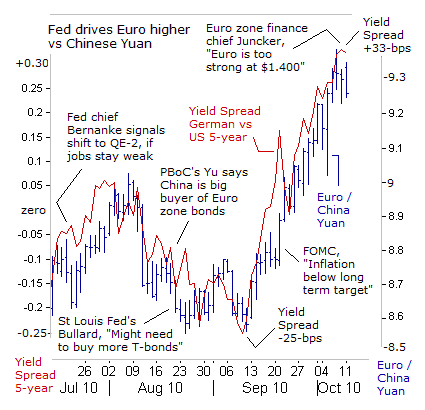
A further rise in the Euro's value against the Chinese yuan and the US-dollar could further undermine global demand for the Euro-zone's industrial exports, which prompted the Euro-zone's finance chief Jean-Claude Juncker to warn on October 8th, "The Euro is too strong today," as it crossed $1.400, and just a few hours ahead of a meeting of finance ministers and central bankers of the G-7 clique. "I don't think the US-dollar is in line with underlying fundamentals," Juncker said.

At a meeting with Chinese Prime Minister Wen Jiabao, ECB chief Jean "Tricky" Trichet, Jean-Claude Juncker, and the EU's Monetary Affairs chief Olli Rehn, called for "a significant and broad-based appreciation" of the Chinese yuan, to at least match the Euro's rebound against the US-dollar. Yet at the same time, the Euro-zone leaders praised China's commitment to purchase debt issued by troubled Greece, a measure that would boost the Euro vs the yuan.

Behind the scenes, the Fed engineered the Euro's recovery by submerging the yield on the US-Treasury's 5-year note below Germany's 5-year bund yields. So far, the ECB has refused to intervene to halt the Euro's rally. The ECB is skeptical in principle of interventions, - buying and selling currencies to affect exchange rates. However, if the Fed signals a larger than expected blast of QE-2 in November, the Euro could climb higher, and complaints from Euro-zone industrialists would follow. At that point, the ECB might cast aside its principles, and begin printing Euros and start buying bonds denominated in foreign currencies.
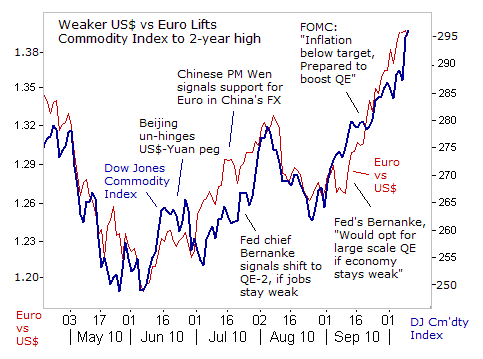
QE-2 fuels Commodities Rally, Since July 21st, Fed chief Ben "Bubbles" Bernanke has floated trial balloons about the unveiling of QE-2, and engineered a sharp fall in the US-dollar against the Euro, Japanese yen, Swiss franc, and emerging currencies. The weaker dollar has fueled "hot money" flows into emerging stock markets, lifted gold to record heights at $1,365 /oz, fueled silver's parabolic rally to 30-year highs, and global commodity indexes have climbed to two year highs.

On Sept 21st, the Fed made it clear that given the US-labor markets' weakness, it's determined to prevent a deflationary spiral. That's a widespread drop in wages, prices of goods and services, stock portfolios, and the value of homes. Under a cloak of deceit and deception, the Fed is reviving the animal spirits among speculators, and whetting the appetite for risk taking, by driving interest rates to historic lows and crushing the value of the US-dollar. The Fed's gambit is succeeding! Traders are now bidding-up commodities, shares of commodity producers, and precious metals, before the next tidal wave of QE-2 floods world money markets.

Soybeans jumped to $11.78 /bushel in Chicago, up +7% this month. Corn prices saw their biggest two-day rise since 1973, up 12.7% to $5.75 /bushel, as expectations of a drastic shortfall in crop production raised fears of a repeat of the global food crisis of 2007-2008. Already there's talk of the necessity rationing corn next year. Coffee and cotton have surged to their highest levels in 15-years, and in Shanghai, rubber futures rallied by their daily limit to their highest in four-years.
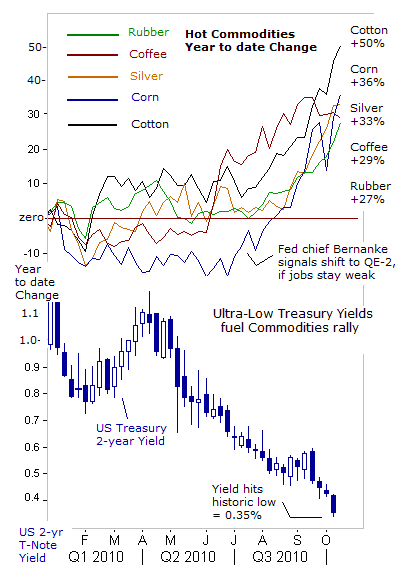
London copper rallied to around $8,400 /ton, its highest since July 2008, and aluminum extended a rally to touch $2,438,/ton. Shanghai zinc soared 5% to its upside limit of 18,875 yuan /ton, and US light crude oil topped $83 /barrel, as the US-dollar weakened against the Euro. So while Americans are losing their jobs and their homes, the Fed is making matters worse, by inflating the cost of the basic staples of life. Another key driver behind the resurgence of the "Commodity Super Cycle" is the slide in the US Treasury's 2-year yield to historic lows of 0.35% this week, essentially ruling out any hike in the fed funds rate until 2012.
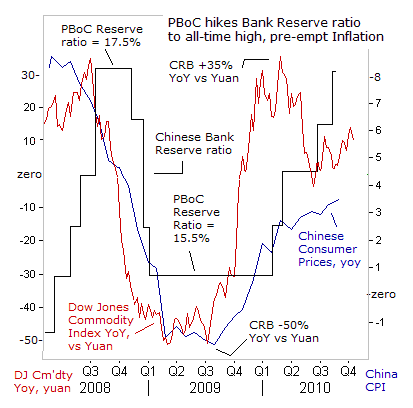
Food and energy account for about half of the budgetary outlays for the population in China and India that live on less than $2 /day. Thus, the central banks in the world's top-2 fastest growing economies are more willing to tighten monetary policy in order to combat inflationary pressures from higher commodity prices. According to Beijing's apparatchiks, China's consumer price index (CPI) was creeping +3.4% higher in August from a year ago. But China's CPI could be galloping ahead at a +5% clip or more, if global commodity markets continue to soar.

On October 11th, the People's Bank of China (PBoC) tried trying to deflate a powerful bubble in global commodity prices, and asset price inflation, by mopping-up excess yuan in the Shanghai money markets. The PBoC hiked reserve requirements for China's six largest banks, by a half-point to 17.5%, tying the highest level in history. Earlier this year, in January, global commodity and stock markets fell sharply after China surprised the traders by hiking reserve requirements a half-point to 16-percent. But on this latest occasion, traders simply yawned.

This time around, the PBoC's tightening moves have been neutralized by the Fed's plan to unleash $500-billion or more of QE-2. The Fed and the US Treasury are threatening to take the inflationary effects of super-easy money to the extreme limit, even though QE-2 won't bring down the US-jobless rate. Instead, the impact of QE-2 could be felt more acutely in China and India with sharply higher commodity prices, and perhaps, followed by tighter monetary policies. At some point, Beijing might see the logic of allowing the yuan to rise faster against the dollar, utilized as a tool to help keep the imported price of commodities under control.

In both Japan and the United States, short-term interest rates are so close to zero-percent that their central banks have resorted to nuclear QE in a bid to drive down long-term bond yields. But these radical measures have failed to boost economic growth. With fiscal stimulus packages being pared down, in order to rein-in bloated budget deficits, and zero-percent interest rates failing to produce jobs, politicians are seeking to expand exports, by reducing the value of their currencies, as the sole remaining measure available to provide an economic boost.

Warning of the danger of currency wars, IMF Managing Director Dominique Strauss-Kahn told finance chiefs of the G-7 industrial powers and the emerging economies of Asia and Latin America, "There is clearly the idea beginning to circulate that currencies can be used as a policy weapon. Translated into action, such an idea would represent a very serious risk to the global recovery." Yet the global currency system itself, and the entire network of economic relations built upon foreign trade, - is already breaking down under the weight of QE- in England, Japan, and the US, and the daily rigging of currencies in the emerging world.

Through stealth intervention in the foreign exchange market, Japan's central bank has accumulated the world's second largest stash of FX reserves, reaching $1.1-trilion in September. The size of Japan's FX has also swelled reflecting the inflated value of its holdings of European and US-Treasury bonds. Last moth, the BoJ held 765-tons of gold in its vaults, equal to only 2.7% of its FX reserves. Gold dealers have long recognized that at some point, Tokyo would eventually end its folly of accumulating paper currencies, and instead, would see the logic of switching more of its bloated FX stash into hard assets, such as gold or silver.

In an interesting move last week, Japan's ruling Democratic Party proposed taking advantage of a strong yen to invest part of Japan's $1.1-trillion stash into securing natural resources in overseas markets, thus raising the stakes in a global battle with Beijing for strategic assets. Thus, the global "currency wars," revolving around the Chinese yuan, can resurrect the "Commodity Super Cycle," and establish Gold as the key medium of exchange that can guarantee banks' promises to pay depositors, promises to redeem note holders, or to secure faith in a currency.

Wednesday, October 13, 2010

Silver Price Manipulation: The Public Deserves Answers


By Rob Mackinlay:

US regulators have been urged to reveal the results of a two-year-long investigation into silver and gold price manipulation allegations. The findings are keenly awaited by investors and organisations who have been making allegations about silver and gold price manipulation for decades.

The investigation was based on a claim that large traders, like banks, had been selling huge amounts of silver on the futures market to keep prices down. A substantial short position - believed to be equivalent to 25% of the annual global mining supply of silver - was exposed during the financial crisis.

Bart Chilton, a commissioner at the US Commodities Futures Trading Commission (CFTC), which is investigating the claims, said: 'I think the public deserves some answers in the very near future.'

He said: 'I expect the CFTC to say something on our silver investigation within weeks. I can't pre-judge what that will be. I can't even guarantee that the agency will speak. That said, if the agency remain silent for much longer, I intend to speak out on the matter in an appropriate fashion.'

Geoffrey Aronow, a former CFTC investigator, told Citywire that there was a chance the investigation could affect silver prices: 'I would say that, generally speaking, results of investigations have not had direct market impacts, but it may depend on whether the Commission concludes that there is any ongoing questionable conduct.'

Ben Davies, chief executive of Hinde Capital, a london-based gold hedge fund manager said that it looked like the activity which had raised the original concerns had stopped and so a direct effect on the price of silver was unlikely.

Back in March 2010 Chilton suggested that CFTC investigators had made significant discoveries: 'We have looked at the silver market like we have never before and I think there is a window of success that has been opened for understanding about what has been going on and why.'

In the statement he said this was the first full investigation into the silver market since 1979 when the Hunt brothers cornered the market and the silver price spiked.

Until 2008 the CFTC believed that these allegations were groundless, a view still held by some gold experts.

The Keiser Report - Spewing Up Paper

Max and Stacey discuss Central Banks opening the spigot of money creation and how the market is responding by spewing up $US. It seems you can only force feed the market so much money before it chokes on it. Of course the owners of gold are cheering on the increasingly futile actions of the Fed and IMF.

Rick Santelli Interviewed


CNBC's veteran commentator Rick Santelli is interviewed by Eric King on King World News about the commodities market, gold, interest rate manipulations, QE and more......listen here

The Fed's Zero Rate Policy Is Destroying America


From the Business Insider:

By Christopher Whalen, an Institutional Risk Analyst of Lord, Whalen LLC.

In this issue of The Institutional Risk Analyst, we turn the camera eye on two different perspectives on the continuing crisis affecting the U.S. economy, the Fed's deflationary monetary policy and the surging price of gold. We look at how the rapid changes now underway in how consumers and investors alike view the dollar will affect the risk picture facing banks, companies and individuals. BTW, tomorrow IRA cofounder Christopher Whalen will be travelling back to the heartland to visit our friends at Indiana State University. We will give a talk entitled: "Do Americans Need a New Deal?" More on this theme next week.

Last week The IRA traveled to Washington D.C. to participate in the latest event sponsored by our friend Alex Pollock at American Enterprise Institute, "Living in the Post-Bubble World: What's Next?" We received a great deal of media buzz before and after the event, but the most poignant comment came in this unexpected and very disturbing letter from Dianna in Rockford, IL:

"I have no way of knowing if this message will ever actually reach you. Nevertheless, I want to extend a most sincere message of appreciation for one of the comments you made during recent participation in an American Enterprise Institute symposium. You are the only financial guru /analyst whom I have heard make any reference to the devastating impact of extraordinary quantitative easing on "grandma" and her carefully laid financial plans. Many middle class retirees have no generous government or corporate pension. We have had to plan and save prudently for retirement. Now, as we watch returns on CD's plunge from an average 5% to an anemic 1.5%, we also experience a plunge from a comfortable retirement into a state of severe "penny-pinching". You were correct...not only do we have to cut back on gifts for the grandchildren, we are also drastically curtailing many discretionary purchases, travel to spend time with family and so forth. I have heard NO other analyst speak to this impact on responsible retirees who thought they had done all the right things to prepare for the "golden years". It just felt good to realize that there is at least one individual who has given any consideration to this fallout from "Fed" policies."

Now you know why we at IRA take time away from our business to engage in public debate about how the world of finance affects real people. And you also see the horrible damage that the Bernanke Fed is inflicting upon real American in order to bail out the large Wall Street banks. And the irony is that all of this damage and sacrifice by Dianna and tens of millions of American individuals and businesses who depend upon interest income to survive will be for naught. The Big Banks will have to be restrructured in any event using the resolution authority in the Dodd-Frank legislation.

We also heard from our friend Henry Smyth, proprietor of Granville Cooper Asset Management Ltd., which features a unique gold fund that is comprised solely of rolling forward positions in the noble metal. The fund is domiciled entirely out of reach of America's spendthrift government and settles via Julius Baer in Zurich. (Disclosure: IRA co-founder Chris Whalen is a neighbor of Smyth and an introducing party of GCAM.)

Smyth, who we know from our Mexico days, has been pestering us since the summer about a chart created by his colleague Zeke Brustkern that illustrates the growth of the demand for gold over the past decade and how the increased estimates each year understate the actual market performance. Click here to see the gold chart which Smyth explains below:

"What this graphic aims to elucidate is the evolution of parabolic estimates of the future of gold price over the last five years. Starting with five years of data, from Sept. 2000 through Sept. 2005, a growth projection is forecasted through Sept. 2012. Each subsequent year another projection is crafted adding the additional data points into the curve's slope estimate. Five curves are portrayed in all, representing data from Sept. 2000-Sept. 2010, all projecting through 2012. What becomes clear is that despite using estimation methods intended to represent rapid parabolic growth, the estimated values continue to fall short of the real asset value appreciation. With the exception of 2008/2009, each passing year has brought substantial upward revision of growth projections, and has continued to do so throughout 2010."

Consider these two data points: First, an American retiree named Dianna who has seen her retirement savings rendered worthless by the ill-considered policy actions of the Federal Open Market Committee. Second, the action of the gold market, which is likewise suggesting that fiat paper dollars have no value. If you take the two observations together, it suggests to us that the Fed's actions are feeding global deflation and that the next leg down in the U.S. financial markets could be particularly severe -- especially if the Fed resumes printing more funny money.

While some analysts are calling for a mild devaluation of the dollar, what we see forming ahead could be something far more dramatic and potentially disruptive to the world economy, namely a protracted period of deflation driven by the subserviant position of the Fed vis-a-vis the largest banks. This new shrinkage will not only see gold moving higher but will also see the dollar collapse a la the FDR dollar devaluation of the early 1930s. This crisis is being caused by Fed zero interest rate and quantitative easing ("QE") policies.

As we have said before and we'll say again, the FOMC's zero rate policies imply that the dollar and all assets denominated in dollars have no value. Stocks, bonds and other financial assets depend upon income to make these obligations money good. Without a positive return, there is no reason to hold dollar assets. When President Abraham Lincoln introduced fiat paper dollars backed by nothing to finance the Civil War, these pieces of debt originally were convertible into Treasury notes that paid interest. But the need of a growing nation for a means of exchange rendered such devices irrelevant.

Today the situation is reversed. Non-commercial demand for dollars is collapsing in much of the global economy, in part because the Fed is transferring something like three quarters of a trillion dollars annually from individual and corporate savers to the Wall Street banks. And even this vast subsidy will be insufficient to prevent the ultimate restructuring of the top three U.S. banks. What will Fed Chairman Ben Bernanke and the other members of the FOMC say to Dianna and the millions of other Americans impoverished by their policy errors when we have to break up the top-three U.S. banks anyway?

Forget more QE. If the FOMC does not soon allow interest rates to rise and thereby rebalance the policy equation between American savers and borrowers, then we fully expect to see gold prices climb further. Fed Chairman Ben Bernanke and the FOMC will hand the detractors of the central bank led by Rep Ron Paul (I-TX) the political issue they need to eliminate the Fed once and for all. And President Barack Obama will be wearing the concrete booties that once belonged to President Herbert Hoover. Unlike your worthless greenbacks, you can take that to the bank.

Yale Ph.D., And Former Fed Member Tells Obama To Pull A "Gordon Brown" And Sell All Of America's Gold


From ZeroHedge:

Edwin Truman, a senior fellow in the Peterson Institute, who is of course a former Fed member, and of course a Yale Ph.D., writes in the FT, suggesting the brilliant idea that it is high time for the US to sell its gold. In other words do precisely what Gordon Brown did a few thousand percent ago, and now has to defend against allegations he did so merely to protect the LBMA cartel which was on the verge of being margin called into oblivion. And even if one ignores the fact for a minute that there has not "really" been an audit of the US gold holdings in who knows how long, who is to say that Goldman, of all people, may not be right and gold will be at $1,700 in a year? Or Dylan Grice for that matter, and it will be about 10 times higher. One thing is certain: converting real hard asset value into paper to patch up 2.25% of government debt as a % of GDP is easily the dumbest idea we have ever heard. Especially, since as we disclosed yesterday, the Fed will have to force Congress to increase its deficit, and thus debt funding needs, simply so that there are enough Treasuries for the Fed to monetize. We hope Mr. Truman is in the contention for next year's economic and peace Nobel prizes, because with articles such as this he has certainly proven he belongs to that unique category of brilliant economists that only Princeton, Yale and Harvard can produce.

From the article:

Gold is back in the news. Its price is soaring in what some analysts say is a reflection of a weak economy and a lack of confidence in government policies. Naturally, investors are looking at a new sure thing in the expectation that prices will continue upward. My advice to the US government, however, is that this may be the best time – to sell. Doing so would help President Barack Obama and Congress reduce indebtedness, at little cost.

It is an article of faith in bullion markets that the US will be the last country to dispose of its gold stock. For 30 years it has had a no-net-sales policy for reasons ranging from resistance by US gold-producing interests to concerns about the international monetary system. That assumption may remain plausible. Yet the administration has an obligation to re-examine its policy.

And now for kicker #1: gold is up due to "fraud and misinformation" - oddly there is no mention of the fraud accompanying the Keynesian ponzinomics that the world is fighting tooth and nail to preserve:

The market price of gold has risen for more than a decade propelled by low interest rates, the hype of the bullion dealers (holding large inventories) and no doubt the normal amount of fraud and misinformation accompanying asset price bubbles. The Financial Times has reported that the precious metals industry expects the price to increase by a further 11 per cent over the next year.

So here is Truman's modest proposal: take the gold, convert it to linen, and use it to patch up just over 2% of US debt. Brilliant

Meanwhile, the US Treasury holds 621.5m fine troy ounces of gold. The government has been sitting on that gold since the Great Depression, receiving no return. At the current market price of $1,300 per ounce, the US gold stock is worth $340bn. The Treasury secretary, with the approval of the president, has the power to sell (and buy) gold on terms that the secretary considers most beneficial to the public interest. Revenues from sales must be used to reduce the national debt.

If the US were to sell its entire gold stock at the current market price, it would reduce the gross government debt by 2¼ per cent of gross domestic product. Based on the average interest cost from 2005 to 2008, this reduction in debt would trim the budget deficit by $15bn annually. Thus, the Obama administration would be doing something about the US fiscal debt and deficit without reducing near-term support for the ailing economy.

Kicker #2: Truman had graduated from economist to financier, recognizing the importance of buying (or confiscating as the case may be) low and selling high:

This proposal has several other benefits. First, the US would be obeying the maxim to buy low and sell high. Second, it would be performing a socially useful function. Demand for gold exceeds normal production, driving up the price. To the extent that the gold craze is being fed by concern (rational or irrational) about government policies, public welfare would be enhanced by giving citizens something tangible to hang around their necks or place in safe deposit boxes. Third, if the price is a bubble, as seems likely, the sooner it is burst the better for the average investor.

Lest Truman be accused of being a biased idiot, he himself provides some counter arguments to his Darwin award worthy suggestio:

Some people point to possible costs. Aside from political pressures from those who want to protect the value of their holdings, above or below ground, two principal arguments are made against US gold sales. The first is that such sales would disrupt the market. But the US government can be cautious in its sales, avoiding disruption of gold sales programmes of other countries, as it has in the past. There is little risk. In recent years, sales under the Central Bank Gold Agreement have dwindled, and some other central banks are buying gold. (The US is not a party to the agreement.) Also the International Monetyary Fund has completed more than three-quarters of its own planned sales of 403.3 metric tons.

Another counter argument is that the US should hold on to its stock in anticipation of the return to a monetary system based on gold by itself or with other nations. Returning to the gold standard would reinstate a system that has not existed for a century, however. It is not going to happen. The gold standard was associated with unstable prices, wages, output and employment. The current official discussions of the reform of the international monetary system do not include any advocates of a return to gold, and the IMF articles of agreement prohibit doing so. The sooner thoughts of a return to the gold standard are laid to rest, the better. A related argument for retention of the US gold stock is as a “rainy day” precaution. But after the recent economic and financial crisis and with the prospect of further misery for several more years, how much more rain must pour before the US acts?

So now you know - the gold standard "is not going to happen." What else is there to say - arguing with such brilliant logic which sees the benefits in 100 years of dollar devaluation, coupled with the greatest credit bubble ever, which has led the world to the precipice of all out currency, trade and soon, actual, war and assumes that the barbarous relic is actually worse than this is, well, pretty much pointless

Wall Street Begins To Fear Nightmare Foreclosure-Gate Scenario Where All Of Housing Finance Is Wrecked


From Business Insider:

A great report from Diana Olick at CNBC titled: Foreclosure Fraud: It's Worse Than You Think.

The gist: industry folks are getting really nervous that all this robo-signing and document fraud could infect the entire housing finance ecosystem.

She cites Georgetown Law Prof Adam Levitin who recently went on a Citigroup call to discuss the issue with investors.

Here's what he tells Olick about a possible nightmare scenario as it pertains to regular mortgage situations -- not just foreclosures:

The mortgage is still owed, but there's going to be a problem figuring out who actually holds the mortgage, and they would be the ones bringing the foreclosure. You have a trust that has been getting payments from borrowers for years that it has no right to receive. So you might see borrowers suing the trusts saying give me my money back, you're stealing my money. You're going to then have trusts that don't have any assets that have been issuing securities that say they're backed by a whole bunch of assets, and you're going to have investors suing the trustees for failing to inspect the collateral files, which the trustees say they're going to do, and you're going to have trustees suing the securitization sponsors for violating their representations and warrantees about what they were transferring.

If this were to come to pass -- and plaintiffs lawyers will certainly be eager to show that their clients were paying the wrong mortgage holders -- the value of all instruments (including the performing ones) could plummet.