Tuesday, September 28, 2010

Gold is the final refuge against universal currency debasement


By Ambrose Evans-Pritchard (UK Telegraph):

States accounting for two-thirds of the global economy are either holding down their exchange rates by direct intervention or steering currencies lower in an attempt to shift problems on to somebody else, each with their own plausible justification. Nothing like this has been seen since the 1930s.

“We live in an amazing world. Everybody has big budget deficits and big easy money but somehow the world as a whole cannot fully employ itself,” said former Fed chair Paul Volcker in Chris Whalen’s new book Inflated: How Money and Debt Built the American Dream.

“It is a serious question. We are no longer talking about a single country having a big depression but the entire world.”

The US and Britain are debasing coinage to alleviate the pain of debt-busts, and to revive their export industries: China is debasing to off-load its manufacturing overcapacity on to the rest of the world, though it has a trade surplus with the US of $20bn (£12.6bn) a month.

Premier Wen Jiabao confesses that China’s ability to maintain social order depends on a suppressed currency. A 20pc revaluation would be unbearable. “I can’t imagine how many Chinese factories will go bankrupt, how many Chinese workers will lose their jobs,” he said.

Plead he might, but tempers in Washington are rising. Congress will vote next week on the Currency Reform for Fair Trade Act, intended to make it much harder for the Commerce Department to avoid imposing “remedial tariffs” on Chinese goods deemed to be receiving “benefit” from an unduly weak currency.

Japan has intervened to stop the strong yen tipping the country into a deflation death spiral, though it too has a trade surplus. There is suspicion in Tokyo that Beijing’s record purchase of Japanese debt in June, July, and August was not entirely friendly, intended to secure yuan-yen advantage and perhaps to damage Japan’s industry at a time of escalating strategic tensions in the Pacific region.

Brazil dived into the markets on Friday to weaken the real. The Swiss have been doing it for months, accumulating reserves equal to 40pc of GDP in a forlorn attempt to stem capital flight from Euroland. Like the Chinese and Japanese, they too are battling to stop the rest of the world taking away their structural surplus.

The exception is Germany, which protects its surplus ($179bn, or 5.2pc of GDP) by means of an undervalued exchange rate within EMU. The global game of pass the unemployment parcel has to end somewhere. It ends in Greece, Portugal, Spain, Ireland, parts of Eastern Europe, and will end in France and Italy too, at least until their democracies object.

It is no mystery why so many states around the world are trying to steal a march on others by debasement, or to stop debasers stealing a march on them. The three pillars of global demand at the height of the credit bubble in 2007 were – by deficits – the US ($793bn), Spain ($126bn), UK ($87bn). These have shrunk to $431bn, $75bn, and $33bn respectively as we sinners tighten our belts in the aftermath of debt bubbles.. The Brazils and Indias of the world are replacing some of this half trillion lost juice, but not all.

East Asia’s surplus states seem structurally incapable of compensating for austerity in the West, whether because of the Confucian saving ethic, or the habits of mercantilist practice, or in China’s case by the lack of a welfare net. Their export models rely on the willingness of Anglo-PIGS to bankrupt themselves.

So we have an early 1930s world where surplus states are hoarding money, instead of recycling it. A solution of sorts in the Great Depression was for each deficit country to devalue, breaking out of the trap (then enforced by the Gold Standard). This turned the deflation tables on the surplus powers – France and the US from 1929-1931 – forcing them to reflate as well (the US in 1933) or collapse (France in 1936). Contrary to myth, beggar-thy-neighbour policy was the global cure.

A variant of this may now occur. If China continues to hold down its currency, the country will import excess US liquidity, overheat, and lose wage competitiveness. This is the default cure if all else fails, and I believe it is well under way.

The latest Fed minutes are remarkable. They add a new doctrine, that a fresh monetary blitz – or QE2 – will be used to stop inflation falling much below 1.5pc. Surely the Fed has not become so reckless that it really aims to use emergency measures to create inflation, rather preventing deflation? This must be a cover-story. Ben Bernanke’s real purpose – as he aired in his November 2002 speech on deflation – is to weaken the dollar.

If so, he has succeeded. The Swiss franc smashed through parity last week as investors digested the message. But the swissie is an over-rated refuge. The franc cannot go much further without destabilizing Switzerland itself.

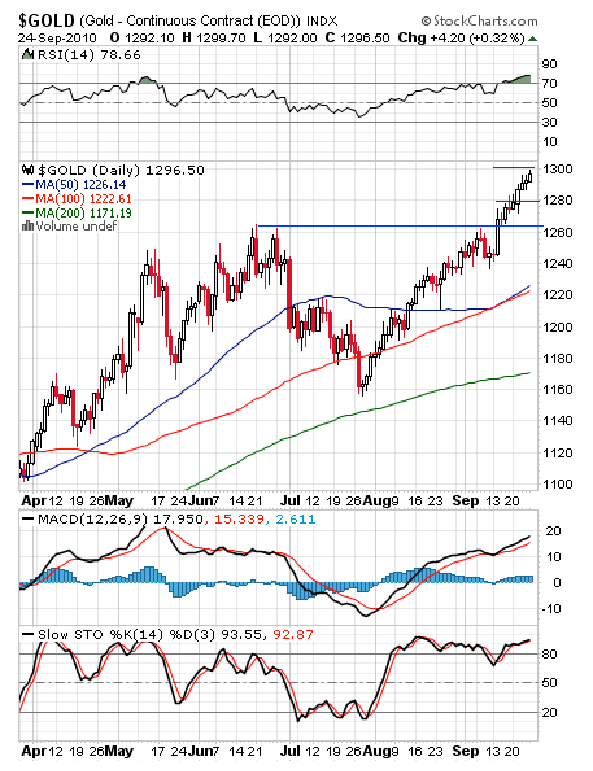
Gold has no such limits. It hit $1300 an ounce last week, still well shy of the $2,200-2,400 range reached in the late Medieval era of the 14th and 15th Centuries.

This is not to say that gold has any particular "intrinsic value"’. It is subject to supply and demand like everything else. It crashed after the gold discoveries of Spain’s Conquistadores in the New World, and slid further after finds in Australia and South Africa. It ultimately lost 90pc of its value – hitting rock-bottom a decade ago when central banks succumbed to fiat hubris and began to sell their bullion. Gold hit a millennium-low on the day that Gordon Brown auctioned the first tranche of Britain’s gold. It has risen five-fold since then.

We have a new world order where China and India are buying gold on every dip, where the West faces an ageing crisis, and where the sovereign states of the US, Japan, and most of Western Europe have public debt trajectories near or beyond the point of no return.

The managers of all four reserve currencies are playing fast and loose: the Fed is clipping the dollar; the Bank of England is clipping sterling; the European Central Bank is buying the bonds of EMU debtors to stave off insolvency, something it vowed never to do just months ago; and the Bank of Japan has just carried out two trillion yen of “unsterilized” intervention.

Of course, gold can go higher.

Savers told to stop moaning and start spending


The following is a report from the UK Telegraph. It is amazing that the guys in charge of the Bank of England don't seem to have the faintest idea how Capitalism works. You need Capital to have Capitalism! If people aren't encouraged to save, by greater than inflation returns, then there will be no capital to provide loans to business to manufacture goods and employ people. No wonder many Britons are turning to gold &silver to protect their wealth when people like this are in charge of the money supply.

From the UK Telegraph:

Savers should stop complaining about poor returns and start spending to help the economy, a senior Bank of England official warned today.

Older households could afford to suffer because they had benefited from previous property price rises, Charles Bean, the deputy governor, suggested.

They should "not expect" to live off interest, he added, admitting that low returns were part of a strategy.

His remarks are likely to infuriate savers, who are among the biggest victims of the recession. About five million retired people are thought to rely on the interest earned by their nest-eggs. But almost all savings accounts now pay less than inflation.

The typical savings rate has fallen from more than 2.8 per cent before the financial crisis to 0.23 per cent last month.

Mr Bean said he "fully sympathised". But he continued: "Savers shouldn't necessarily expect to be able to live just off their income in times when interest rates are low. It may make sense for them to eat into their capital a bit."

He added: "Very often older households have actually benefited from the fact that they've seen capital gains on their houses."

In an interview with Channel Four News on Monday night, he said that savers "might be suffering" from the low Bank Rate. But they had done well from higher rates in the past and would do so again.

Mr Bean said that encouraging Britons to spend was one reason why the Bank had cut interest rates. They have been held at 0.5 per cent for 18 months, hitting rates offered on savings accounts.

The strategy had led to Mervyn King, the governor, receiving many letters of complaint.

But it was designed to return the economy to a reasonable level of activity as quickly as possible, he said. "The faster we can achieve that, the sooner interest rates will get back to more normal levels."

Had the Bank not acted, "unemployment would have been higher, wage growth would have been lower," Mr Bean added.

The comments angered groups representing the elderly and those putting money aside. The Daily Telegraph has campaigned for protection for savers.

Ros Altmann, director-general of Saga, said: "Savers are being taken advantage of. They did the right thing and have been let down at the other end of the deal.

"I don't think this is what most people would consider fair."

Dot Gibson, of the National Pensioners Convention, said: "For years we've been told to put money aside for our retirement only to find that interest rates have sunk and now we have to use our savings just to pay the bills."

Jason Riddle, of Save Our Savers, said: "The Bank was aware that there was a lack of saving before the financial crisis, but those who were prudently saving while others spent, are being heavily punished."

Official figures show that savers have lost about £18 billion a year in interest as a result of the Bank's response to the worst recession in a generation.

The amount Britons save has fallen by more than a fifth since the start of the year, a survey showed today.

The average person is saving £102 a month, down from £130 in February, according to Santander.

Silver's Breakout


From The Equedia Network Corporation:

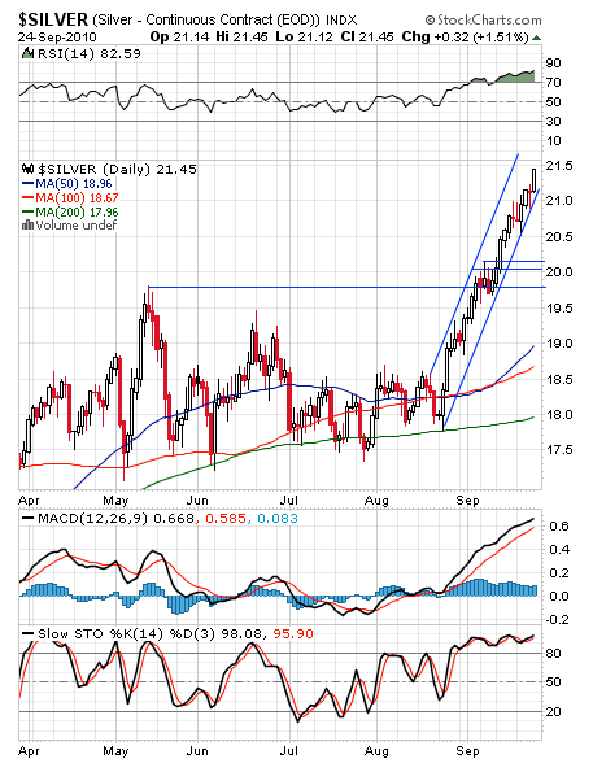
It finally happened. Through months of struggle, silver has finally managed to crack the $20/oz mark.

In past newsletters, we touched on the positive signs of why silver, along with gold, should outperform and continue to see new highs. After months of what many believed to be market manipulation, silver finally took the edge and surpassed the $20 barrier.

Although a few dollars above recent highs may not seem important, there's much more to it than meets the eye. The Gold to Silver Ratio (GSR) has finally broken the technical downside. This not only signals a strong push in silver prices, but it also means an increase in both industrial and investment demand for silver.

For the last five thousand years, the GSR has been somewhere around 16 to 1. This means that one ounce of gold can buy 16 ounces of silver. Coincidentally, that ratio remains relatively constant for the amount of silver versus gold in the world. For every ounce of gold in the ground, there is roughly 17.5 ounces of silver.

In recent years, the average gold and silver price spread has been about 60 to 1. If silver where to catch up with the GSR that has been around for the last five thousand years, silver prices today should be nearing $80/oz. Of course, this isn't going to happen anytime soon. However, silver is now trading even better than gold. Shorts and sell-offs are increasingly shallow and silver is now managing to close higher when gold has been lower.

That's because silver is not just a safe haven play. Unlike gold, which goes up during times of great political, economic, and social strife, silver is also an industrial metal that can climb with a growing economy - not to mention the possibility of price manipulation.

The Debt Debacle

We already know that US and worldwide government debts are climbing. This should mean an increase in the price of both gold and silver. But that's where silver has its advantage. As economies around the world recover and grow in the next year, demand for industrial use silver will, too. This means when market environments appear safer, silver will continue to climb - but gold may fall.

The Double-Edged Metal

Silver is one of the most-versatile metals, with new silver patents exceeding those for any other metal, leading to new industrial uses every year, and ever-increasing demand. Even the monitor of your computer screen or that new HD flatscreen you were just watching, has a few ounces of silver in them.

Meanwhile this same industrial demand is strengthened by the biggest surge in investor demand for silver in several decades.

The trace-uses of silver result in vast quantities of silver being "consumed" every year, permanently reducing the amount of available silver in the world - unlike gold, where all quantities ever mined are available or recoverable......read on

Charting New Space

By Warren Bevan:

Resistance is futile. Gold is charting into new frontiers. We're now on the road towards $1,500 Gold and $30 silver. Both targets should be reached with this move which should last until perhaps spring.

There will be consolidations and corrections along the way, but it really doesn't get much better than this. Let's get right into the fantastic looking charts this week.

Metals Review

Gold rose nicely, by 1.73% on the week and butted up against the psychological resistance at $1,300 early Friday before falling due to profit taking the rest of the day.

The $1,300 level may take a bit of time to clear, but then again maybe not. When something is in all-time high territory there is no telling what can happen and when. What I can say is that I'm very, very impressed with Golds move so far.

It's moved up slowly and steadily, backing and filling and testing and holding support levels along the way. It's textbook, and very pleasing to see.

If anyone tells you this is a bubble or parabolic blowoff their crazy! This is a sustainable move. Many stocks I was trading last week moved up well above 3% in a single day while Gold was up under 2% on the whole week.

The GLD ETF saw good fairly strong volume on the week with very strong showings a couple of days. All in all the volume tells me we should continue to move slowly, steadily higher.

Silver rose a strong 3.42% for the week and it is right at bull to date highs dating back to March 2008. To find a silver price any higher you'd have to go all the way back to the 1980 era.

If silver moves up even a few cents it could spark the move to $30. It could happen quite quickly. Silver has certainly moved up rather quickly but who's to argue with it?

All you can do now is enjoy the ride until it ends......read on

Gold’s Historic Rally Continues


By Brady Willett:

Gold broke above $1300 an ounce on Friday and silver ended at a new 30-year high. Whether these gains are sustainable over the near term is impossible to comment on. What can be said is that gold is likely to remain in a long-term uptrend so long as the central banks continue to try and manipulate currency and asset prices, and/or the outlook for fiscal deficits remains worrisome. In other words, gold and silver today serve as both a hedge against the downfall of fiat money and the threat of major sovereign default(s).

The Demand Drivers

There used to be a time when the COT data was important; when the investor looking to buy or sell gold could study the data to glean excellent points of entry/exit. To say that the COT statistics have become completely irrelevant may be an overstatement. However, the recent data is definitely of little utility to the average investor. In the case of last week (as of September 21), commercial short interest as a percentage of open interest declined for the third week in a row and net small spec long interest barely moved higher even as the price of gold launched by more than $25 an ounce. If the small specs are not chasing rallies and the commercials are not looking to short the heck out of any large move higher, why bother to even look at the COT data? Quite frankly, the expectation of a commercial triggered wipeout in the price of gold (and silver for that matter) has all but vanished. This is not to say that forces will not pile on to try and trigger stops and/or manipulate prices when a pause in buying arrives, only that it is impossible to forecast such an event beforehand.....read on

Monday, September 27, 2010

Truth about Markets - London


Truth about Markets London - Max & Stacy discuss Gold, Bonds being sold between Govts. and much more........listen here

There Are Now Enough Vacant Properties In China To House Over Half Of America


From Business Insider:

Property stocks in China were weak today due to media reports that the Beijing and Shanghai authorities were investigating the high vacancy rate for Chinese property. Markets are worried they'll be shocked by what they discover and clamp down on speculation even harder than they have.

How large might the vacancy problem be? Here's a taste:

Finance Asia:

Recent statistics show that there are about 64 million apartments and houses that have remained empty during the past six months, according to Chinese media reports. On the assumption that each flat serves as a home to a typical Chinese family of three (parents and one child), the vacant properties could accommodate 200 million people, which account for more than 15% of the country’s 1.3 billion population. But instead, they remain empty. This is in part because many Chinese believe that a home is not a real home unless you own the flat.

And so people prefer buying to renting, and as a result, the rental yield is relatively low.

Why would so many properties be held vacant? They're seen as long-term investments, even if renters aren't available. This is due to the dearth of investment options available to most Chinese, butting up against their rapid wealth creation.

They need to put their money somewhere, but the stock market is under pressure and bank interest doesn't cover inflation. So they plunk their money into a new property, just as a place to store their wealth, even if they don't intend to live in the place and can't find renters.

Multiply this behavior by a few hundred million, and the result is enough vacant properties to house over half of America.

US Gold CEO Expects Gold Price of $5,000


From Xinhuanet:

BEIJING, Sep.25 (Xinhuanet) -- International gold prices rallied to record highs on Friday, with spot prices nearing 1300 US dollars an ounce. China's gold prices followed the trend and continued to climb. But consumer enthusiasm hasn't been affected.

It's China's traditional gold rush. The peak season for gold sales coincides with the two national holidays.

Impacted by a weaker US dollar and holiday consumption, international gold prices hit record highs.

In China,the price of pure gold exceeded 340 yuan per gram (?). But consumer enthusiasm is just as high as the gold prices.

One resident said "For us, the price is very high. But we need to buy gold now since the price continues to increase."

Consumers have flooded into gold shops, to find their perfect accessory.

Liu Ru, Sales Manager of Gold Shop said "Chinese people share a concept. That is to buy gold when the price is climbing. Since now it is holiday, many customers buy gold accessories as presents for relatives and friends. And also it is wedding season, increasing gold demand."

Silver prices have also soared, and even reached a 30-year high... making investments in the grey metal more attractive than ever.

Analysts say the continuous decline of the US dollar has stimulated investors to choose safe haven products such as gold.

And with high consumption and investment demand, gold prices will continue to rise in coming days.

The Forgotten Man


The Forgotten Man ©2010 Jon McNaughton
Click Link for Larger Image and More Info