
Tuesday, October 12, 2010

How High For Silver & Gold?

By Jeff Nielson:
For obvious reasons, there are few questions asked as regularly of precious metals commentators as "how high do you think the price of gold and/or silver can rise?" Before I look at what is implied when people ask that question, I will discuss the answers to that question - and what is implied by these estimates.
The starting-point is to go back to when the bull market began for precious metals, at roughly the turn of the millennium. At that time, the small number of informed, precious metals commentators who occupied this niche were "estimating" that the price of gold could hit $1000/oz - with the more confident/bullish pundits suggesting that gold might even reach $2,000/oz.
Skip-ahead to today, and now any experienced precious metals commentator who estimates $2,000/oz as a "ceiling" for the price of gold is seen as being extremely conservative. Veteran precious metals commentator, Lorimer Wilson, recently surveyed these analysts, to compile a list of such estimates - in order to set some parameters for these prices.
He found five commentators currently suggesting that the price of gold could eventually exceed $10,000/oz, nearly two dozen who chose figures between $5,000 - $10,000/oz, and than another dozen who had specifically chosen $5,000/oz as their price target. He added more than two dozen other estimates of between $2,500 - $5,000/oz - and didn't include (or couldn't find) a significant number of informed commentators expecting anything less than that.
What happened between then and now? Were those earlier commentators simply not as aware or astute with respect to the potential of precious metals? Hardly. As a commentator who was not one of the first to become an advocate for precious metals, I have great admiration for the "first generation" of commentators who were here before myself.
Not only did they demonstrate superior insight in seeing what was happening before others, but they also demonstrated extraordinary courage and conviction in being ready to stand up and make their predictions for this sector - when it was literally the most-unloved asset-class among all Western investors.
What has changed since $2,000/oz was originally seen as a long-term maximum for the price of gold is that our currency-debauching bankers keep "moving the goal-posts". Put another way, the bankers have accelerated the destruction of their cherished, paper currencies so rapidly that the earlier predictions were rendered obsolete.
In short, while the original "gold bugs" were seen as extremists and alarmists, in fact their only 'sin' was to underestimate the monetary depravity of bankers. Thus, we have established the proposition that rather than being shrill "Chicken Littles", that precious metals commentators have been making sober, conservative appraisals of the economic harm caused by the extreme excesses of bankers - in the absence of the Gold-Standard.
This leads us to a second proposition: given the reasonable, responsible efforts of precious metals commentators to apprise us of the relative appreciation of gold and silver versus banker-paper, the rate of change of such estimates provides a reasonable "proxy" for the speed at which the bankers are destroying these fiat-currencies - and most notably the US Dollar, the world's "reserve currency".
It is extremely useful to identify such a proxy, living in a world where our governments use heavily-contrived statistical fictions as a means of deceiving rather than informing us. Listen to clueless, media talking-heads yammer on about a "gold bubble", listen to the same vacuous voices talk about "near-zero inflation", and you can rest assured that you will live in a state of perpetual ignorance regarding the rate of destruction of our paper currencies (and the paper wealth they represent).
As useful as these commentators' future estimates of gold and silver prices are, however, it recently occurred to me that such literature is very likely concealing a very large "blind spot" regarding the economic analysis conducted by precious metals commentators. Specifically, we run into nothing less than a logical disconnect when our analysis turns toward a subject with great relevance for the precious metals sector: hyperinflation.
Let me spell this out in detail. All investors who have attempted to familiarize themselves with this sector will be aware of the dire and sincere warnings from these same commentators that our economies are seriously at risk of setting off a hyperinflationary price-spiral. Most of these investors will be familiar with the esteemed economist, John Williams (of Shadowstats.com), and his even more explicit warnings that "U.S. hyperinflation" could commence as soon as this year.
A recent comment by a reader revealed to me that I have not explained/explored this topic in sufficient detail to eliminate the "logical disconnect" which I just mentioned. Specifically, most people "understand" the concept of hyperinflation well enough to realize that such an economic catastrophe ends with the paper-currency of that economy collapsing to zero.
Note that when such paper reaches zero, that this necessarily implies that the "price" of gold and silver in such a worthless currency is literally infinite. Even those people who didn't excel in "math" will understand that there is a rather large gap between $10,000/oz and infinity.
This brings us (at last) to what is implied by any/every commentator who engages in price-forecasting with respect to silver and gold. Either such commentators are only making "medium-term" estimates for gold and silver prices, or that commentator is implicitly rejecting the possibility of hyperinflation - or the commentator simply doesn't understand what hyperinflation really is.
In saying this, I'm not attempting to denigrate any other commentators. Indeed, being a "numbers guy" my entire life, I have always been highly cognizant of the increasing level of "mathematical illiteracy" in our societies. Part of this "illiteracy" is directly attributable to the enormous defects in our education systems. However, the other aspect of this lack of comprehension is that we are being exposed (for the first time) to mathematical concepts which are far more abstract or complex than anything which our ancestors ever needed/attempted to understand.
"Hyperinflation" is just such a concept. Not only do we need to carefully define this concept before we can possibly understand it, but we need to construct a definition where "understanding" is within the grasp of the average person. Here we run into a second "disconnect". Economists and other scholars looking at related issues have indeed constructed several definitions for hyperinflation.
In the conclusion to this commentary, I will argue that such definitions are not accessible to the average person, and thus are not helpful in educating the general public about this very important concept. I will construct my own, less rigorous definition - and then will apply that definition to the issue of analyzing gold and silver prices.
Gold & Silver Breakout

By Dr. Jim Willie:
The increasingly visible vote of no confidence in the fast failing USGovt financial structure, and in the missing capital formation apparatus that was once Wall Street, and in the entire avalanche of paper in debt monetization to undermine valuation, is the GOLD & SILVER PRICE. Both metals are breaking out to the upside. They are registering votes of NO CONFIDENCE. Gold & Silver are put in investment portfolios to hedge against monetary system breakdown. They are insurance policies for private wealth, to protect from erosion of money through sponsored sanctioned monetary inflation. A deep problem with the current strategy of monetizing debt and inflating debt to a reduced level, is that it betrays creditors. It forces a debt write-down on creditor investments in USTreasurys and US$-based securities. It invites retaliation in trade war, whose financial expression is COMPETING CURRENCY WAR.
The financial friction is reaching a higher level each month. On Tuesday, the Bank of Japan announced a cut to 0% interest rate, this being done a full 20 years after their financial crisis stuck them with the dead-end 0% interest rate. The advantage of a trade surplus helped Japan for two decades. That surplus has disappeared, handed over to their Asian rival China. The two nations are in hot disputes in the last month. The ramping Competing Currency War is better described as a race to the bottom, in which only GOLD & SILVER win. Anyone wondering why an inert metal would prevail over investment in a financial structure or debt parade is simply obtuse and of dull mind. Gold represents money in a land where money has been systematically debased. Money today is nothing more than debt in disguise, and legal tender is nothing but denominated debt. The system is on the verge of failure, complete with failure of state, due to the cancerous nature of its faulty money. The high priest apologists have lost credibility after regular justifications for a sequence of failed theories. Gold & Silver are refuges.
My forecasts in the past have been for a $1300 gold price, now achieved. My forecasts in the past have been for a $21.50 silver price, now achieved. The two precious metal markets are in a clearly recognized bull market breakout. The big banks are on the defensive, covering shorts, almost their entire positions being underwater. They will strive to shove their portfolios into some USGovt closet, like Fannie Mae or AIG or a hidden USDept Treasury device. The deceptive commentary has become humorous, about gold being in a bubble. Be amused by it, if not horrified by it. Alarm systems are never bubbles. Gold is indeed a hedge, but against many misfortunes.
- The gold market represents a hedge against the USTreasury bubble.
- The gold market represents a hedge against the breakdown of the monetary system.
- The gold market represents a hedge against coordinated wreckage of the currencies by the central banks, resulting in uniformly lower purchase power of money.
- The gold market represents a hedge against a ripple effect from a global spread of sovereign debt writedowns, defaults, and their extension to the currency system.
- The gold market represents a hedge against the insolvent banks.
- The gold market represents a hedge against an extended banking system shutdown.
- The gold market represents a hedge against heightened trade war and great destruction.
- The gold market represents a hedge against the loss of wealth, plainly stated.
- The gold market represents a hedge against the US systemic failure in progress.
- The gold market represents a hedge against the inevitable USTreasury default, whatever final form it takes.
- The gold market represents a safe harbor for money, since it is true money.
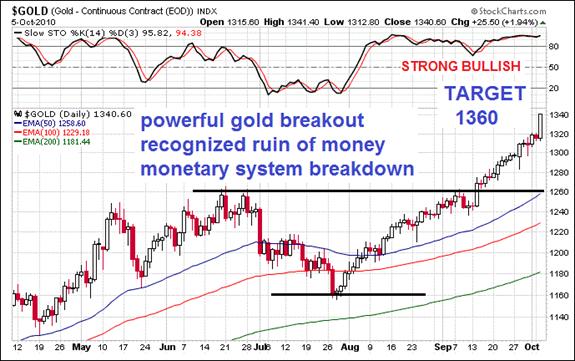
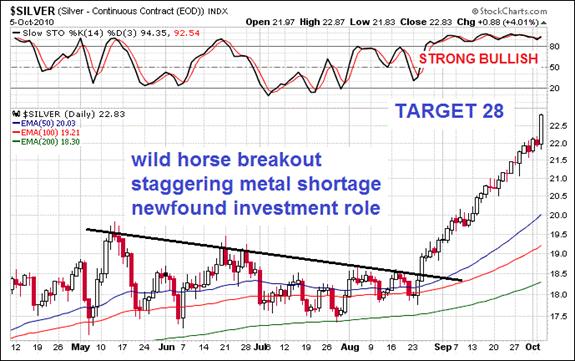
Gold & Silver are investments in legitimate money. Gold & Silver are votes of NO against the Fascist Business Model and its trappings. Gold & Silver are investments in bullion whose price in no way properly reflects the diverse shortages and contract shorting by official chambers without benefit of metal collateral. Gold & Silver are investments in grossly under-priced bullion whose move toward equilibrium will bring about price advances of multiples higher, not just hefty percentages higher. Prepare for $3000 gold and $80 silver. Support of the US$ DX index at the 78 level is not holding. A further slide below 77 will invite calls for direct global USDollar intervention, and another upward thrust in the Gold price. The huge move in the Gold price over $25 and the huge move in the Silver price over $1.00 in a single day on Tuesday was triggered by the Bank of Japan, which registered commitment to the Competing Currency War. The issue is not inflation versus deflation, but rather of systemic breakdown and the focus on tainted money, if not lost store of value. The Gold price will show a mid-term top only when anything is fixed. The USTreasury Bond rally is a loud signal of systemic failure. There is liquidity all around, supposed at zero cost, but it is all hemlock. It is not INFLATE OR DIE, but rather INFLATE & DEFAULT. The stock market is the distraction steeped in irrelevance, since stocks could rally, but money is losing value.
In case sleepy observers have not noticed, Team Obama in the economic dugout just disbanded. Nobody is left except a hologram inside a great void. In the president's hip pocket is found a copy of "Dialectical of Materialism" without much public notice. The helm is empty. The Ship of State is adrift, a derelict vessel. Peter Orszag is gone (broken budget, spiraling deficits). Christina Romer is gone (wise mediocrity but ignored). Lawrence Summers is gone (loser preppy). Cindi Sparks is gone (stimulus plan architect). One can only hope that Tim Geithner departs too. Although not on any economist team, the exit of Rahm Emanuel should be interpreted as meaning that Obama is a political liability. Running for Chicago Mayor might raise difficult questions on his resume, best not asked, since he wears two hats. The legacy of US economic counselors in the past two or three decades has been heresy reinforced by rationalization, embellished by obfuscation, touted as erudite, ignorant of history. They stand atop unsound money, having lost the concept of money, industry, and income. In the current pathogenesis of systemic failure and debt default, Gold wins!
Online Pawnbroker Sees 300% Rise in Gold Loans

LONDON, October 12, 2010, PRNewswire
With gold prices on the stock exchange hitting its eighth record high in 2 weeks, the soaring prices are beginning to have an effect well beyond the confines of the Bank of England.
Gold has traditionally being seen as a safe haven in times of uncertainty, 2010 has proved no different, Pawnbrokers too have seen a big expansion in their gold loans as people hedge their bets as to whether prices will rise further.
Online pawnbroker Borro.com has seen a 300% rise in Gold loans from the first quarter of 2010 to the last. That is due to the fact that a new loan applicant would receive a 22% larger loan offer now than they would have received than at the start of the year for the same items or gold weight.
Furthermore savvy customers are making the most out of the rises as people can release money from their gold without having to sell their items.
Paul Aitken, CEO of Borro, comments, "As gold prices have risen we have seen a huge increase in gold related loans coming into our offices. There's trinkets, engagement rings, antique bullion, there was even a jeweller who took advantage of our prices needing a loan against a large amount of his own goods."
A Which report* found pawnbroker Loans represented much better value than TV advertised gold buying services, where pawnbrokers loaned nearly three times the amount that buying services were prepared to pay.
Individuals that have gold in their possession posses a wealth of options and can get value in the current marketplace. Will the price of gold rise further? It's a distinct prospect and will closely follow the economic trends and the fortunes of the larger global economies.
Sunday, October 10, 2010
Osborne Says He'd Approve a Bank of England Request for Monetary Stimulus

From Bloomberg:
Chancellor of the Exchequer George Osborne said he is prepared to give the Bank of England the green light for more monetary stimulus if the central bank judges it’s needed to keep the U.K. economy from slipping back into a recession.
Osborne said he will bow to any decision made by the central bank’s nine-member Monetary Policy Committee, led by Governor Mervyn King, to expand its 200 billion pounds ($319 billion) bond purchase program, a strategy called quantitative easing.
“If it makes judgments, then I would basically follow those judgments,” Osborne told reporters in Washington, where he is meeting ministers and central bank governors at the International Monetary Fund.
The Bank of England kept up emergency stimulus and left its interest rate at a record low as officials debate whether to join a global push to pump more aid into the world economy. The pound rose to an eight-month high against the dollar this week following the decision, which came after official Adam Posen stoked speculation that the bank could loosen monetary policy as soon as this month.
Other central banks are already signaling they will inject more economic stimulus to shore up a flagging global recovery. The Bank of Japan this week established a 5 trillion yen ($60 billion) fund to buy assets. U.S. Federal Reserve Chairman Ben S. Bernanke said on Oct. 4 that further asset purchases may help the U.S. economy.
‘Staggered Plan’
Osborne also softened his rhetoric on his plan to implement the biggest squeeze on government spending since World War II, saying that, because it will be spread out over several years, it won’t derail economic growth.
“We have a staggered plan over four years,” Osborne said. “It does not come into effect overnight.”
Earlier this week, Osborne told the Conservative Party’s annual conference that the U.K. risks the downgrading of its top-notch credit rating, market turmoil and rising interest rates if it delays cuts to public spending.
He said he was “doing it by the book” by cutting welfare, taxing consumption and reducing tax and regulatory burdens on companies so that they can stimulate growth. He said an increase in the value-added tax and an income tax increase to 50 percent for the highest earners introduced by his Labour Party predecessor, Alistair Darling, together with his own plan for 6 billion pounds of spending cuts this year hadn’t hurt the economy.
“I don’t think you can point to a material impact on the U.K. economy this year,” Osborne said.

David Frost - Interviews Tony Blair
Gold rises 1 percent on weak payrolls, Fed easing hopes

NEW YORK |
NEW YORK (Reuters) - Gold rebounded 1 percent on Friday a day after a sharp retreat, as a weak U.S. employment report spurred buying by investors who expect the Federal Reserve will start buying government debt again to stimulate the economy.
It was the fourth consecutive weekly rise for both gold and silver. For the week, silver was up 5 percent, outperforming gold's 2 percent rise.
A U.S. Labor Department report showed the U.S. economy shed jobs in September for the fourth month in a row as government payrolls fell and private hiring slowed.
Miguel Perez-Santalla, vice president of sales at Heraeus Precious Metals Management, said that the weak jobs data should push the Fed toward trying to stimulate growth through what is known as quantitative easing, or QE2 as the market calls it.
"Quantitative easing means more money in the system. With that, there's going to be possible market devaluation. And as the currencies lose value, how do you protect against that? A lot of people are looking into gold," he said.
Spot gold was up 0.9 percent at $1,344.35 an ounce at 2:58 p.m. EDT (1858 GMT) , after peaking at $1,349.70 an ounce in earlier trade.
U.S. gold futures for December delivery settled up $10.30 an ounce at $1,345.30. Final volume was about 195,000 lots, 50 percent above its 30-day average, preliminary Reuters data showed. COMEX gold open interest eased but held near a record high 621,941 lots as of Wednesday.
Gold prices were choppy early, hitting a session low of $1,324.85 an ounce after St. Louis Fed chief James Bullard said policy makers face a tough decision at next month's meeting.
The Reuters-Jefferies CRB index, a global commodities benchmark, hit two-year highs as U.S. grains and oil markets led a broad commodities rally, while the dollar slipped to new lows against a basket of major currencies.
The dollar fell 7.5 percent last month versus the euro, its biggest monthly decline since December of 2008.
SOME BRACE FOR CORRECTION TO RALLY
Gold has rallied about 10 percent since the end of August. It hit a record high on Thursday of $1,364.60 an ounce before finishing lower for the day. The precious metal is viewed as a hedge against inflation and dollar depreciation. (Graphic: r.reuters.com/kaf27p )
Some investors thought gold's sharp drop on Thursday after hitting a record high might signal the start of a correction. Hansen said a resilient dollar may yet keep gold from rising too high.
Gold investors are also waiting to see how this weekend's annual meeting of the International Monetary Fund and World Bank will affect foreign exchange markets.
The world's largest gold-backed exchange-traded fund, New York's SPDR Gold Trust, reported a 13.4 tonne outflow on Thursday, the biggest one-day drop in its holdings since late July.
Commerzbank wrote in a note that the outflows from gold ETFs signal that short-term speculators caused the latest swift rise in gold prices. Among other precious metals, silver surged 2.8 percent to $23.15 an ounce, near Thursday's 30-year high of $23.51 an ounce. Platinum rose 0.5 percent to $1,699.50 an ounce, while palladium climbed 0.9 percent to $584.50.