Showing posts sorted by relevance for query schoon. Sort by date Show all posts

Thursday, February 16, 2012

Gold fire sale

By Darryl Robert Schoon

Today, central bankers, the mandarins of capitalism, are in disarray. Their attempts to contain capitalism’s current crisis increasingly resemble the tactics of a defeated army in retreat. Like Napoleon and Hitler’s respective “Moscow moments”, the 21st century economic crisis has brought to an end the bankers’ spectacular 300 year run at the table of power and wealth.

The indebting of others as a means of accumulating wealth ends when the indebted can no longer pay what they owe. The arcane and esoteric scribblings of second generation University of Chicago trained economists cannot cover up this basic fact, i.e. that the indebted are broke; and soon, their creditors will be as well.

The bankers’ franchise of credit and debt built on a leveraged foundation of paper money fractionally backed by gold allowed the West to accumulate geopolitical power and wealth on a vast scale. That era is now over.

It ended when the gold convertibility of the US dollar was terminated in 1971 when the cost of maintaining a global military presence outstripped the ability of the US to pay in gold what it owed on paper.

It was as if someone removed a pin from the axle of international commerce when the US dollar was no longer convertible to gold. Previously, the US dollar was linked to gold, and other currencies were linked to the dollar. Everything was stable. It is no longer so. Once the pin connecting gold and paper money was removed, everything changed. The axle of international commerce began to vibrate and lately it’s been getting much worse. The fear is that the wheels are now about to come off. - Section 1, topic 3, How to Survive the Crisis and Prosper in the Process, Schoon, 2007

Today’s fragile state of the euro, a fiat currency created in a failed European attempt to compete with and/or replace an increasingly unstable US dollar, is but another indicator that the wheels are now about to come off.

After the US ended the gold convertibility of the US dollar in 1971, gold skyrocketed from $35 per ounce to $850 in 9 years, increasing almost 2,500% in value, dwarfing the later rise of the Dow (from 777 in 1983 to 11,722 in January 2000) a much smaller rise of 1,400% over almost twice the time (17 years instead of 9).

After gold’s spectacular ascent, central bankers decided the price of gold needed to be ‘managed’, as a rapidly rising price of gold signaled that something was fundamentally amiss with the bankers’ fiat paper money, a signal that central bankers did not want sent, a signal that bankers would work exceedingly hard to disguise for the next 40 years.

When stocks lose their value
That’s a terrible thing
When homes lose their value
That’s a terrible thing
But when money loses its value
That’s the most terrible thing of all


Introduction, How to Survive the Crisis and Prosper in the Process, Schoon, 2007

CENTRAL BANKERS MANAGE THE PRICE OF GOLD

In actuality, central bankers did not work ‘exceedingly hard’ to disguise the real market demand and price for gold. Instead, bankers disguised market demand not by hard work, but by smoke and mirrors, a contrivance common to confidence men everywhere and, today, to central bankers in particular.

To suppress the price of gold, central bankers covertly supplied markets with gold bullion belonging to the nations on whose behalf they ostensibly toiled, suppressing gold’s real price with excess supply. This artifice was discovered by Frank AJ Veneroso, an extraordinary financial analyst and consultant well known only in the rarefied circles of international finance.


According to Veneroso, since the early 1980s central bank gold sales and loans comprised a significant portion of all gold sold. In 1990, Veneroso estimates that 21.5% of gold sold that year came from central bank vaults; and by 2000, central bank gold sales had increased to over a 1/3 (34.6%) of all gold sold.

Frank Veneroso’s story of central bank manipulation of gold markets is found here.

With thousands of tons of central bank gold coming onto the market, it’s clear why the price of gold declined from 1980 until 2001. What is remarkable, however, is that in the face of such overwhelming supplies, the price of gold began to rise in 2001.

THE TURNING POINT

The turning point, however, actually occurred in 1999 and is marked by an event relatively unknown and almost tantamount to financial treason. About that event, I wrote in March 2009:

In 1999, it was rumored that investment bank Goldman Sachs had a 1,000 ton gold short position in the markets. Goldman Sachs was betting that the price of gold would continue to fall and they would be amply rewarded for their apparent “risk”.

Because of central bank manipulation, the price of gold had moved inversely to the rise of stocks for almost 20 years and bankers were making easy money on the bet gold would continue its downward spiral.

However, much to the shock of Goldman Sachs and the central bankers, in 1999 gold stopped falling; and, because Goldman Sachs’ short position was so large, Goldman possibly could suffer catastrophic losses.

This is when England’s then Chancellor of the Exchequer, Gordon Brown, on May 8, 1999 announced England would sell over 50% of its gold reserves, 415 tons of the most precious metal on earth at the very bottom of the market.

The decision to sell England’s gold thereby saved Goldman Sachs and insured the political future of Gordon Brown. Goldman Sachs’ is still in business and Gordon Brown is now [2009] the Prime Minister of England - proving that good things come to those who do the bidding of the powerful (whether either outcome was worth 415 tons of England’s gold is questionable).

Selling a nation’s gold to save the bankers’ parasitic system is now common practice as the banker’s system continues to collapse and gold continues to rise. Since Gordon Brown sold England’s gold, gold has risen from $275 dollars per ounce to its present price of over $900 despite the thousands of tons of central bank gold sold to prevent its inexorable movement higher.[On 2/14/12 gold is $1,715]

CENTRAL BANK SALES AND LEASING OF GOLD HAS MADE GOLD AVAILABLE AT FAR BELOW MARKET RATES

To hide their burning house of cards, central bankers have sold thousands of tons of gold from national treasuries, mainly Switzerland, to keep the price of gold below what it would otherwise be. This is the true upside (for buyers) of the bankers’ gold suppression scheme.

While citizens cannot prevent central bankers from selling gold from their national vaults, today they are afforded the extraordinary opportunity to buy that very same gold on the open market at prices heavily discounted to their otherwise true market value.

My current estimate of today’s true market value of gold - without central bank intervention - is in excess of $10,000 dollars per ounce.

Many central banks, however, are today switching sides in the war on gold, preferring to keep their precious metals instead of selling them in an increasingly futile attempt to prevent the inevitable from happening - the collapse of the bankers’ now burning house of cards.

Today, the bankers’ fiat currencies are in a death spiral. It’s only a matter of time until the US dollar, the Japanese yen, the British pound and all paper currencies - including the Chinese yuan - come under the same pressure that now plagues the faltering euro.

Central bankers, however, will do everything in their considerable power to prevent their lucrative franchise of credit and debt based on paper money from collapsing; and, of late, they’ve discovered a new way to suppress gold and silver - the precious metal inventories of GLD and SLV, the precious metal ETFs used by investors to participate in the rising price of gold and silver.

When Europe’s debt contagion spread in the summer of 2011, the price of gold began moving rapidly higher which bankers feared could itself turn into runaway contagion. The below chart shows that GLD and SLV, the ETF funds, were used by central bankers to cap gold and silver prices in mid-August.


Source - www.gotgoldreport.com

Amid growing concerns about Europe’s debt crisis as gold rapidly rose, GLD sold 26.12 tonnes of gold and SLV sold 304 tonnes of silver, driving the price of silver down 8% although gold rose 4.9% despite GLD’s considerable efforts to the contrary.

That GLD and SLV ostensibly dedicated to profit from the rising price of gold and silver would sell their inventories in a rapidly rising market runs counter to their mandate; unless, of course, they did so knowing that central banks would soon ambush gold and silver with deeply discounted lease rates on precious metals that would cut short gold’s increasingly spectacular rise.

Jesse’s CafĂ© Americain traces the planned ambush of gold by central banks during their September take-down, read article here. Gold had risen to a record high, $1900, on September 1st and on September 2nd, central banks then took corrective action, dropping their lease rates for gold sharply lower into negative territory.

This meant that central bankers would actually pay bullion banks to borrow their gold and sell it on the open market. The new supplies of gold capped gold’s increasingly steep seven month rise and, by the end of September, the price of gold fell back to $1600.

After Sept 2nd, gold lease rates still remained negative, insuring a continued low price for gold even as the European debt crisis accelerated and the global economy slowed. This is exactly what central bankers intended. Gold is a barometer of systemic distress and central bankers wanted to conceal the flames rising from their now burning house.

Nonetheless, even with negative lease rates, gold again began moving higher before central banks on February 2nd supplied markets with more gold with again sharply lower lease rates deep in negative territory.


As the bankers’ ponzi-scheme of credit and debt disassembles, central bankers will find it more difficult to contain the price of gold; and when gold does break out - as it will - the price of gold will exceed the $10,000 price it would now command if it were not for central bank intervention.

At $1700 gold is cheap; at $3,000 gold is cheap; at $5,000 gold is cheap; at $7,000 gold is cheap. Wait till the central bank sale ends and you will realize how cheap gold actually is.

The wheels are now coming off the bankers’ once invincible juggernaut. Whether the out-of-control bankers will crash in a (1) hyperinflationary blow-off, (2) a brutal never-ending deflationary collapse-in-demand or (3) in a fatal bursting of capitalism’s bloated colostomy bag - derivatives - cannot be known.

But what is known is that the end of the bankers’ monetary fraud is near and its demise closer than most want to believe.

THEY’RE NOT LAUGHING ANYMORE

A remarkable blog, www.dailystaghunt.com, reviewed recordings of Fed Open Market Committee meetings between 2000 and 2006 and, interestingly, noted the frequency of laughter during meetings, observing: The number of recorded laughs actually increased in frequency from 2000 to 2006. In 2001, the FOMC erupted into laughter 16.5 times per meeting on average. In 2003, it was over 19. In 2005, 27. And then in 2006, the FOMC burst into laughter nearly 44 times per meeting!

As the 2007/2008 financial crisis grew closer, central bankers grew increasingly relaxed and confident; believing their extremely low 1% interest rates had worked; that they had survived the collapse of the greatest speculative bubble in the US since the 1920s - the collapse of the 2000 dot.com bubble - and all was well.

But those in attendance, Greenspan, Bernanke, Fisher, Mishkin, Krozner et. al., were wrong. Their fatally flawed solution to the collapse of the dot.com bubble, low 1% interest rates, had given birth to an even more dangerous bubble, the 2002-2006 US real estate bubble, the largest speculative bubble in the world whose collapse would bring down the world economy in 2007/2008.

Of course, this wasn’t known in 2006. In 2006, central bankers were still laughing.

Frequency of laughter during FOMC meetings

Data on the frequency of laughter at FOMC meetings after 2006 is not yet available. But it can be assumed the frequency subsided after the massive global credit contraction in August 2007 and after the collapse of world markets in 2008.

Note: the possibility that FOMC laughter remained high or actually increased after 2006 is far too macabre to consider. We do, however, await additional data before passing judgment.


Source - www.dailystaghunt.com

Today, central bankers are no longer laughing. Their nights are considerably longer as are their weekends; their daily grocery list might now include quarts of gin and whiskey, prescription anti-depressants and extra-strength deodorant.

We are collectively in the end game, a period of great change where the present paradigm is collapsing making way for what is to come. Keep your thoughts positive and focused on what is coming, not the troubled passing of the present world. Let central bankers do that.

Note #1: I will be speaking at Professor Antal Fekete’s New School of Austrian Economics in Munich, Germany, see http://www.professorfekete.com/gsul.asp. For details, contact nasoe@kt-solutions.de

Note #2: My latest video, What and Who Do Bankers Do (or what I really think about bankers and money).Dollars & Sense show #12, youtube http://youtu.be/hazULFo3oB4

Buy gold, buy silver, have faith.

Darryl Robert Schoon
email: info@drschoon.com
website: www.drschoon.com
website: www.survivethecrisis.comSchoon Archive

Thursday, February 10, 2011

Darryl Robert Schoon - China, Inflation & Gold


China created paper money and paper money…
then created inflation
Darryl Robert Schoon
8 February 2011
Ralph T. Foster in his invaluable book, Fiat Paper Money, The History and Evolution of Our Currency, writes that paper money made its first appearance in Szechwan, a remote province of China early in the 11th century.

Because of a shortage of copper coins, provincial officials had begun circulating iron coins; but the difference in value and weight between the two metals caused unexpected problems.

As Foster writes: [housewives needed] one and one-half pounds of iron [coins] to buy one pound of salt…Paper was the answer. People began to deposit their iron money in money shops and exchanged deposit receipts to transact business.

The money shops' deposit receipts then began circulating as money. But the money shops soon issued more deposit receipts than their supply of coins and by 1022, confidence had eroded in both the notes and the supporting iron money [and] government authorities closed the private note shops.

When the Chinese government intervened, the government quickly discovered the advantages paper money-at least to the issuers. The Sung dynasty immediately banned the issuance of paper notes by private money shops and on January 12, 1024, the Sung court directed the imperial treasury to issue national paper money for general use.

In the beginning, the imperial treasury backed its paper notes with cash coins equal to 29% of the paper money issued. Eventually, however, the Sung, like each succeeding dynasty, would print far more money than it actually possessed in backing.

The consequent loss of confidence in paper money caused Chinese scholars to question the nature of money...Ye Shi (1150-1223) spoke out against excessive amounts of what he called "empty money" when he observed how paper inflation hurt the economy; and scholar Hu Zhiyu (1127-1295) concluded that only backing gave paper value and blamed the retreat from convertibility for the loss of public confidence.. paper money, the child, is dependent on precious metals, the mother. Inconvertible notes are therefore "orphans who lost their mother in childbirth". (page 19)

For the next 600 years, succeeding dynasties would each attempt to utilize the advantages of paper money and avoid its disadvantages. Not one dynasty was able to do so. All attempts to use paper money ended in runaway inflation and dynastic collapse.

By 1661, China finally learned its lesson and the new Qing dynasty officially outlawed paper money. Regarding China's 600 year experiment, Foster writes:

Over the course of 600 years, five dynasties had implemented paper money and all five made frequent use of the printing press to solve problems. Economic catastrophe and political chaos inevitably followed. Time and again, officials looked to paper money for instant liquidity and the immediate transfer of wealth. But its ostensible virtues could not withstand its tragic legacy: those who held it as a store of value found that in time all they held were worthless pieces of paper. (page 29)

Today, almost 1,000 years after paper money first appeared and 350 years after China banned its use, China's is again issuing excessive amounts of paper money; and, once again, paper money's initial prosperity is about to give way to inflation and economic chaos in the celestial kingdom.

Southern Weekly, a Chinese language publication, recently noted: China has not only been the country that prints money at the fastest rate but also been the country with the largest money supply in the world in the past decade. China's M2, a broad measure of money supply, was up 19.46% at the end of November from a year earlier...This compares with 3.3% and 2.5% of annual M2 growth in the US and Japan respectively over the same period…

China's money supply, M2-to-GDP ratio over the past decade is the highest in the world. The nation with the longest history of excessive money printing and consequent inflation has clearly forgotten its past. The past, however, has not forgotten China.

2011: CHINA, INFLATION & THE PRICE OF GOLD

Asian nations, China and India in particular, have a long history with gold. Precious metals as a hedge against chaos is deeply embedded in Asian cultures and when chaos takes the form of inflation, gold is the default hedge; and, today, inflation is on the rise.

China raised interest rates for the third time since mid-October ahead of a report forecast to show inflation accelerated to the fastest pace in 30 months. February 8, 2011, Bloomberg News

This has profound implications for the price of gold. As inflation continues to increase, the buying of physical gold by the Chinese will send the price of gold skyrocketing. In fact, it has already begun.

On February 2nd, the Financial Times reported: Fears of inflation have also driven demand for gold as a retail investment… Precious metals traders in London and Hong Kong said on Wednesday they were stunned by the strength of Chinese buying in the past month. "The demand is unbelievable. The size of the orders is enormous," said one senior banker, who estimated that China had imported about 200 tonnes in three months.

On February 8th, Karen Maley in Australia's Business Spectator discussed this growing phenomenon in her article, China's gold tsunami: It's not hard to understand the growing Chinese enthusiasm for gold. Officially, China's inflation rate was 4.6 per cent in December, but many believe the actual inflation rate is considerably higher. But Chinese savers earn a paltry interest rate of 2.75 per cent on one-year deposits, which means that they face negative real interest rates.

Faced with these dismal returns, Chinese households and businesses have been pouring money into physical assets, such as food, real estate, and commodities as a hedge against inflation. Chinese authorities are now trying to quell property market speculation by making it more difficult for buyers to get bank finance for their second and third investment properties, and have begun experimenting with property taxes in some cities.

This has caused Chinese investors to turn to gold. According to the Sprott newsletter, China, which is already the world's largest gold producer, imported more than 209 metric tons of gold in the first ten months of 2010 alone. This compares with the estimated 45 metric tons it imported in all of 2009.

DON'T WORRY ABOUT 2012
2011 IS HERE

The response to the 2008 global collapse set in motion an even greater danger-runaway inflation. In 2009 world governments attempted to offset the global collapse in demand with historic levels of liquidity. The excessive printing of money has now led to higher prices.

Prices, especially food prices are rapidly rising. Tyler Durden, www.zerohedge.com, makes this point with stunning clarity: One of the benefits of America finally seeing what Zimbabwe went through as it entered hyperinflation, ignoring for a second that the Zimbabwe stock market was the best performing market, putting Bernanke's liquidity pump to shame, is that very soon everyone will be naked, once companies finally realize they have no choice but to pass through surging input costs. And while some may be ecstatic by the S&P's modest rise YTD, it is nothing compared to what virtually every single agricultural product has done in the first month of 2011. To wit: Corn spot up 7.76%, wheat up 5.63%, Rice up 10.08%, Hogs up 10.16%, Sugar up 5.64%, Orange Juice up 3.33%, and cotton.... up 17.08%. That's in one month!

Rapidly rising food prices have already contributed to governments falling in Tunisia and Egypt. Other governments, well aware of the risk that inflationary food prices pose to their continued rule, are now stockpiling food to prevent further protests.

This buying will only drive the cost of food even higher: Jim Gerlach, of commodity brokerage A/C Trading, said: "Sovereign nations are beginning to stockpile food to prevent unrest." "You artificially stimulate much higher demand when nations start to increase stockpiles."

"This is only the start of the panic buying," said Ker Chung Yang, commodities analyst at Singapore-based Phillip Futures. "I expect we'll have more countries coming in and buying grain. www.telegraph.co.uk/news/worldnews/middleeast/8288555/Authoritarian-governments-start-stockpiling-food-to-fight-public-anger.html

INFLATION & THE FUTURE PRICE OF GOLD

Even the hardened paper boys on Wall Street are aware of inflation's impact on the price of gold. The meteoric rise of gold in the late 1970s was caused by rapidly rising prices. In the last decade, however, gold began moving steadily higher as did all commodities in a disinflationary atmosphere. That, however, is about to change.

With gold already moving higher, the increasing inflationary impetus will send the price of gold far beyond its present price. Gold's spectacular ascent in the 1970s is now about to be dwarfed.

Last night, I, Ralph T. Foster, our wives and another couple had dinner together and the topic turned to the future price of gold. There was agreement that while its ascent was certain, gold's ultimate price was a matter of pure conjecture since the reference points used to value that price would be virtually worthless pieces of paper money.

History is the context within which our present circumstances present themselves. Of late, change has been so rapid that many believe the past is merely that which preceded the present. They are wrong.

History is about to repeat itself, albeit in a new iteration. Paper money's journey to the west and back again is about to reach its fatal climax. Paper money's ten-century drama is almost over; and while a new and better era will replace it, the collapse of the present era will be unprecedented in magnitude.

Ralph T. Foster's Fiat Paper Money, The History and Evolution of Our Currency, can be ordered at http://home.pacbell.net/tfdf/ . My latest local TV show, Dollars & Sense, can be viewed at www.youtube.com/user/SchoonWorks#p/a/u/0/0JB4_lFwi4c

Buy gold, buy silver, have faith.


Darryl Robert Schoon
www.survivethecrisis.com
www.drschoon.com
blog www.posdev.net/pdn/index.php?option=com_myblog&blogger=drs&Itemid=81

Tuesday, January 10, 2012

China, 2012 and the Von Mises' Crack-up Boom

By Darryl Robert Schoon

The credit boom is built on the sands of banknotes and deposits. It must collapse... If the credit expansion is not stopped in time, the boom turns into the crack-up boom; the flight into real values begins, and the whole monetary system founders. - Ludwig von Mises, Human Action, 1949

I first attended the Canton Trade Fair in October 1976. All Chinese men and women were dressed in blue shirts and blue pants, bicycles were China’s main mode of transportation, Chairman Mao had just died and China’s mantra, “We will continue to support the policies of Chairman Mao Tse-Tung and criticize the policies of Deng Xiao-Ping”, was heard everywhere.

But three years later when I received White House invitations to attend the Washington DC reception for the Vice-Premier of the Peoples’ Republic of China, it was Deng Xiao-Ping who arrived; not a hard-line inheritor of Chairman Mao’s revolutionary precepts.

In 1977, Deng Xiao-Ping wrested power from China’s conservative communist ideologues and in 1978, opened China’s socialist economy to private ownership. By 2005, China’s private sector had expanded to 70% of its economy and China became an economic power in only 25 years.

While Mao Tse-Tung had successfully steered China away from Western suzerainty, it was Deng Xiao-Ping who put China on the path to financial and geopolitical power; a path that would be as rapid as it would be unsustainable - for China’s explosive growth was founded in large part on excessive credit creation in the West.

Chart source - wikimedia.org

The remarkable rise in China’s GDP reflects the just as remarkable rise of the Dow during the same period.


The correlation between the rise of China’s GDP and the rise of the Dow is unmistakable. It’s also the reason why China’s growth is unsustainable. China’s rapid growth was fueled by the unprecedented expansion of the US money supply - an expansion directly responsible for America’s exploding appetite for consumer goods from China and the US dot.com stock market bubble in the 1990s.


Chart source - www.goldmoney.com

Appointed Fed chairman in 1987, Alan Greenspan presided over the greatest credit and monetary expansion in US history, an expansion which led to America’s three largest speculative bubbles; the 1992-2000 dot.com bubble, the 1991-2006 consumer bubble and the 2002-2006 real estate bubble; three bubbles whose cumulative collapse would derail the world economy and set in motion Ludwig von Mises’ crack-up boom.

THE CRACK-UP BOOM

As von Mises wrote in Human Action in 1949:

... If the credit expansion is not stopped in time, the boom turns into the crack-up boom; the flight into real values begins, and the whole monetary system founders...

Von Mises’ crack-up boom, or more correctly Greenspan’s crack-up boom, had its origins in the 1980s when the US greatly increased spending yet cut taxes and initiated unprecedented levels of borrowing to make up for lost revenues, consequently flooding America with excess liquidity which would set in motion America’s largest stock market bubble since the 1920s.

Although Alan Greenspan had the intellect of an ĂĽber-economist, he lacked the courage to stand up to Washington DC and Wall Street. In the 1990s, when the Dow began rising far out of proportion to economic growth, Greenspan moved to stop the developing bubble in stocks by raising Fed interest rates:

I think we partially broke the back of an emerging speculation in equities. - Alan Greenspan, February 1994

But Greenspan’s rate increase didn’t stop the bubble. Share prices continued higher so Greenspan continued raising rates. After seven consecutive increases between February 1994 and February 1995 and another increase in March 1996, Wall Street demanded Washington DC stop Greenspan from further Fed tightening.

Greenspan capitulated.

...it was not the policy of the Fed to prick bubbles by monetary means. - Alan Greenspan, March 1997

In 1998, Greenspan lowered Fed interest rates three times allowing the dot.com bubble to continue its dizzying liquidity-driven ascent. Finally, in 1999, the Fed was forced to prick the dangerously large stock market bubble which Greenspan now denies recognizing.

My video, Dollars & Sense show #11, titled The Fix Is In, explains Greenspan’s flawed tenure at the Fed and while there are reasons to explain Greenspan’s shortcomings, none can reverse the damage he has done.

Because of his inability to just say no, Greenspan left a legacy of three historic credit bubbles whose catastrophic collapse would trigger Ludwig von Mises’ crack-up boom and send America and the world into the greatest economic meltdown since the Great Depression.

THE GOAT RODEO OF CREDIT DISTORTED DEMAND

The bankers’ artificial injection of credit into free markets ultimately overwhelms supply and demand fundamentals. This distortion, conveniently overlooked during expansions, becomes painfully apparent during contractions when demand disappears leaving behind excess capacity, defaulting debts and high levels of unemployment.

Capitalism’s foundation of debt-based money was destabilized by America’s expansion of its monetary base after 1980; resulting in the eventual overcapacity of supply in the East, e.g. China. Japan, Korea, whose economies had expanded to satisfy the artificially inflated demands of the West, e.g. the US, the UK, Europe.

Capitalism, an always uneasy imbalance between credit and debt, is now trying to regain its balance. It can’t. The present crisis, created by decades of excess credit, is being treated with even more credit; a dangerous palliative that will exacerbate, not solve, what is happening.

Credit expansion is the government’s foremost tool...to contrive everlasting booms, and to make everybody prosperous. – Ludwig von Mises, 1949

Today, China’s late run at capitalism’s table is fueling the very collapse von Mises predicted; for if Greenspan’s credit expansion was excessive - and it was - China has set in motion an even larger expansion.

To offset the global collapse in demand, China expanded its money supply in 2008 by an extraordinary 150%, an increase driven by China’s need to maintain economic growth or risk losing political control.


Modern monetary debauchery is no longer a Western phenomenon. China has now joined the party and in a very big way.

2012, GREAT WAVES AND THE COMING COLLAPSE

The ending of the Mayan calendar in 2012 is as misunderstood as the interplay between credit and debt and supply and demand; but the coincident collapse of the current economic paradigm and an arcane indicator of change should not be dismissed.

Professor David Hackett Fisher in The Great Wave, Price Revolutions and the Rhythm of History writes that for the last eight hundred years, periods of economic and social stability have been intermittently interrupted by waves of rising prices.

Each of these great waves according to Professor Fisher culminated in the economic and societal collapse of the existing order, bringing to an end the Middle Ages, the Renaissance, the Age of Enlightenment, etc.

During each great wave:

...Food and fuel led the upward movement. Manufactured goods and services lagged behind. These patterns indicated that the prime mover was excess aggregate demand, generated by an acceleration of population growth, or by rising living standards, or both.

... Prices went higher, and became increasingly unstable. They began to surge and decline in movements of increasing volatility. Severe price-shocks were felt in commodity movements. The money supply was alternately expanded and contracted.

Financial markets became unstable. Government spending grew faster than revenue, and public debt increased at a rapid rate...Wages, which had at first kept up with prices, now lagged behind.

Returns to labor declined while returns to land and capital increased. The rich grew richer. Inequalities of wealth and income increased. So did hunger, homelessness, crime, violence, drink, drugs, and family disruption.

..Finally, the great wave crested and broke with shattering force in a cultural crisis that included demographic contraction, economic collapse, political revolution, international war and social violence - pp. 237-238, David Hackett Fisher, The Great Wave: Price Revolutions and the Rhythm of History, Oxford University Press, 1996

Great waves take 80 to160 years before they end in the eventual decline and collapse of existing epochs. Today, another great wave is about to crest and break; and the changes could be even more extreme as the amplitude of change is greater than in any previous wave.

The current great wave began in 1896. That it could crest and break in 2012 could be a coincidence. Or, it may not.

GOLD AND THE CRACK-UP BOOM

...[during] the crackup boom...the flight into real values begins, and the whole monetary system founders. - von Mises

Von Mises’ predicted flight into real values - gold - is now underway despite the best efforts of today’s kreditmeisters to diminish the allure of the only safe haven left to those fleeing paper money’s now burning mansion.

One of the foremost proponents of the flight to gold is famed stock market analyst, Richard Russell. According to the Hulbert Financial Digest, Russell’s The Dow Theory Letter is tied for top place as a market timer on a risk adjusted basis since 1980.

A leading financial analyst with a stellar reputation timing stock market trends, Russell’s comments regarding today’s stock markets and gold should be seriously considered and, if appropriate, then acted upon.

On December 17, 2011, Richard Russell wrote:

...The talkers on Bloomberg are discussing stocks to buy. They are unswerving bullish. It never occurs to them that hard times lie ahead and that this is not the time to buy stocks...My advice -- sell any stocks you still own -- sell into all rallies, or stay out of stocks completely.

I continue to like gold in all its forms, but I'm afraid that gold mining stocks will tend to go with the general market. Personally, I'm staying with my gold mining stocks until the bitter end. I continue to believe that we'll see a final hysterical blow-off in gold (the metal) that will carry the mining stocks with it.

On December 31, Russell noted 11 consecutive years of gold closing higher confirms that gold is in a record bull market headed towards an even more explosive high:

This year's close for gold marks the 11th year for higher year end gold closing. To my knowledge this is the longest bull market of any kind in history in which each year's close was above the previous year. This fabulous bull market will not end with a whisper and a fizzle. I continue to believe that the upside gold crescendo of this bull market lies ahead. We are watching market history.


The crackup boom will end as von Mises predicts in monetary disarray, i.e. the debasement of currencies and possible hyperinflation where paper money loses all value. Today, money is no longer a store of value. It’s a trap for the unsuspecting that has already been sprung.

The 300 year viral spread of the banker’s fraudulent paper money is best explained by Gresham’s Law wherein bad money drives out good. But the global success of the banker’s debt-based money has led to its own undoing; for when there’s no good money left, only bad remains.

In 1971, after which gold no longer backed the bankers’ now fiat money, the growth of credit and debt became exponential. Today, they are reaching their limits. Tomorrow, those limits will be exceeded.

Yes, Dr. Keynes, Dr. Friedman, Dr. Greenspan, Dr. Bernanke, et. al. while there are no limits to economic hubris, there are limits to monetary imbalances.

Throughout history, time and time again monetary chaos has led to the explosive rise in the price of precious metals. It’s happening again today.

MIDNIGHT AT THE CASINO

If you haven’t yet cashed in your chips, you should. It’s almost midnight and the casino owners are worried. A run on the cashier’s window would show them to be bankrupt; the casino’s only assets being customer IOUs and banks upon banks of increasingly worn chip-making machines.

The management’s recent offer of unlimited chips to the money changers still on the floor was done in the desperate hope it would convince the remaining gamblers of the house’s solvency.

It won’t work. It’s too late. It’s 2012.

Buy gold, buy silver, have faith.

Darryl Robert Schoon
email: info@drschoon.com
website: www.drschoon.com
website: www.survivethecrisis.com
Schoon Archive

Saturday, April 16, 2011

Darryl Robert Schoon
12 April 2011
Silver, the Canary in the Gold Mine was my talk at a Gold Standard Institute symposium in Canberra, Australia in November 2008. The topic could well describe today's gold and silver markets.

Today, both silver and gold are achieving record highs but silver's accelerating price indicates silver may indeed be the canary in the gold mine, the leading indicator for gold's long-awaited explosive move upwards, a move the Fed and major bullion banks have colluded since the 1980s to prevent.

WHEN ELEPHANTS FLY, IT WILL BE TOO LATE TO BUY

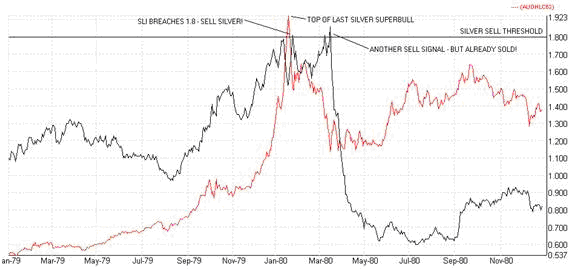
In 1979, the price of silver accelerated along with the price of gold. Silver had spent 1977 and 1978 hovering between $4 and $5 but in 1979 silver began to move upwards-as did gold.

In late January, silver moved to $5.94. Six months later, silver tripled, trading in the $16-$18 range before beginning a meteoric ascent in December, doubling from $17 to $34 , rising 33% on the first trading day in 1980 and peaking January 21st in intraday trading at over $50 per ounce, almost a 1,000 % rise in a year.

Silver (black): gold (red)

On January 21st, gold also peaked at $850. The simultaneous top of both gold and silver is all the more metaphysically coincidental because the factors driving the two metals were far different, i.e. the gold price was being driven by inflation while the Hunt Bros.' squeeze attempting to corner the silver market was responsible for the spectacular ascent of silver.

Now, three decades later, a similar scenario is about to unfold, albeit with a different ending. The current decade will not only repeat what happened in the 1970s but it will bring to its inevitable end that which was set in motion in 1971.

The end of paper money is now in sight.

1970s REDUX
History does not repeat itself, but it does rhyme. -- Mark Twain

On August 15, 1971 President Nixon announced that the US would no longer convert US dollars to gold. For the first time in history, money was no longer gold or silver or convertible to either. On that day, because of Nixon's actions all money everywhere became but government issued coupons with unknown expiration dates.

The reason behind Nixon's extraordinary action was that US gold reserves had been virtually emptied by US overseas military spending. The massive outflow of US dollars needed to maintain America's global military presence had far outweighed any corresponding inflow from America's significant positive balance of trade.

By 1971, it was clear the US owed more far gold than it possessed. The closing of the gold window by Nixon constituted the largest monetary default in history. Now, thirty years later, the final consequences of that default are unfolding.

After 1971, governments everywhere borrowed, printed and spent even more money as gold no longer was a constraint on the global money supply. Additionally, gold was no longer exchanged in order to rectify global trade imbalances.

It was Milton Friedman-the monetary poster boy of the right-who advised Nixon to cut all ties between the dollar and gold. Friedman, like Keynes-the monetary poster boy of the left-was a strong believer in fiat money and Friedman advised Nixon that floating exchange rates would balance global trade flows. Friedman was wrong.

The 1971 cutting of ties between money and gold instead led to increasingly unbalanced trade flows, rapid increases in government debt, and by the late 1970s, increasingly high rates of inflation.

In January 1978, US inflation measured 6.84 %. In January 1979, it was 9.28 % and by January 1980 inflation had risen to 13.91 %. Gold, the traditional refuge from monetary inflation, rose accordingly. In 1978, the average gold price was $193.40. In 1979, it was $306; and in January 1980, gold spiked to $850 with inflation peaking two months later at 14.76 % in March.

In August 1979, President Jimmy Carter appointed Paul Volker to head the Fed hoping to control inflation. Volker's aggressive rate increases brought down both inflation and the price of gold (note: Volker was also responsible for the demonetization of gold in 1971).

Today, aggressive rate increases to prevent high inflation are almost impossible. As inflation moves higher-and irrespective of distorted US figures, it is already doing so-higher Fed rates would end the Fed's liquidity-driven recovery and cause payments on the now astronomical US debt to rise to unsustainable levels.

Expect, then, that gold will move far higher before the Fed is finally forced, if ever, to raise rates. This long-delayed reaction will cause gold to move even higher as a slowing US economy would more than offset any potential rise in the US dollar until the US dollar crashed; and, in such an event, gold would be the only safe haven left standing.

The reason why gold is not rising as rapidly as silver as in the 1970s is because since the 1980s the Fed has focused on keeping the price of gold low Ă  la Gibson's paradox; and, as a consequence, instead of rising equally with silver, gold is lagging and silver is leading.

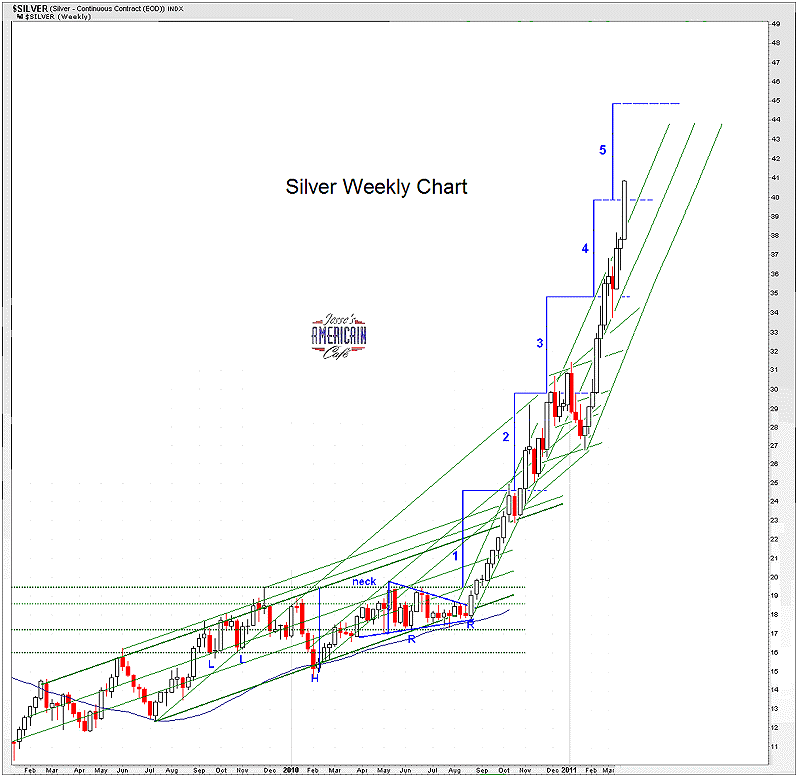
Silver, however, is clearly the canary in the gold mine and as the below chart shows, silver has now broken out.

http://jessescrossroadscafe.blogspot.com

Such a breakout of silver indicates gold could soon follow. This time gold's explosive rise would again be fueled by rising inflation and an unexpected variant of the Hunt Bros. silver squeeze in the 1970s.

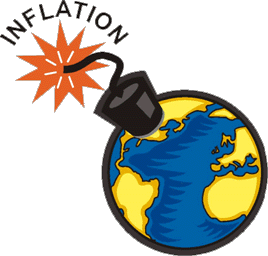
Inflation is already here. Excessive central bank liquidity and loose monetary policies since 2008/2009 have unleashed global inflationary pressures that cannot easily be controlled.

Just as inflation drove gold to a high in 1980, it will do so again today, three decades after Nixon literally pulled the gold out from under the world's monetary foundation. Inflation is now about to finish what Nixon started, the end of fiat money is in sight.

Increasingly consumed by inflation, today's paper currencies will worthlessly inflate ad infinitum and disappear like cotton candy into monetary oblivion like all fiat currencies. This time is no different. Gold and silver will again soar and, as in the 1970s, a short squeeze will again be a factor.

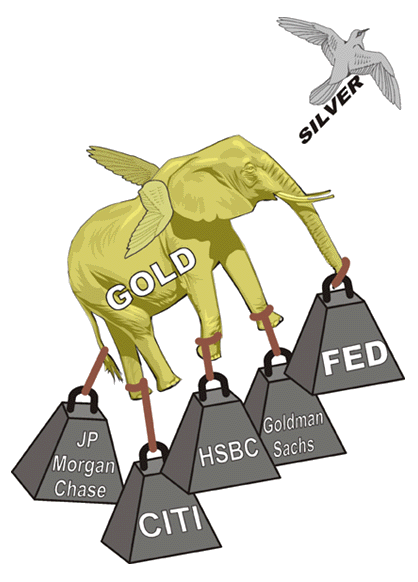
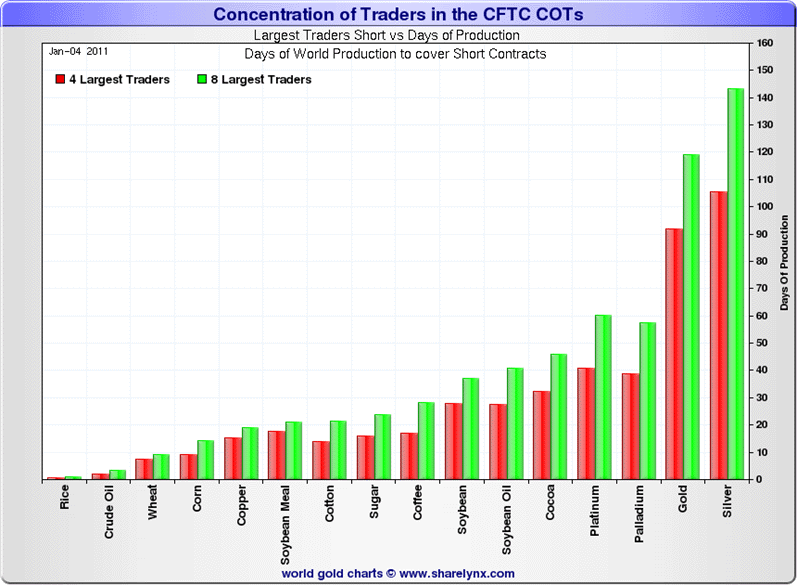
Unlike the 1970s, however, it will not be silver that is squeezed. This time it will be the bullion banks who have colluded with central banks to keep prices of gold and silver low; for as silver and gold rise, at a certain point the bullion banks will be forced to cover their enormous short positions (see below) driving gold and silver higher.

CAPITALISM'S COMING CAULDRON
THE PARADIGM SHIFTS

The collapse of paper money will make the 2008 collapse of financial markets seem like the prelude it is. Capitalism, i.e. economies based on the substitution of debt-based capital for gold, is possible only when capital, i.e. paper money issued by a central bank, is itself tied to the precious metal. In 1971, that changed.

It was the removal of gold from capitalism's monetary foundation that sent capitalism's endgame into motion. Thirty years later, it is reaching its destined end. What will also end is the vast inequities the system encouraged and abetted.

Nobel winner Joseph Stiglitz recently observed that the top 1 % in the US now receives 25 % of America's income and controls 40 % of its wealth. This is to be expected as capitalism rewards those closest to the spigots of credit, i.e. bankers, and those who employ them.

All others are but temporary winners as over time the house cannot be beat-at least not until the house burns down. However, the fire has been lit-the house itself did it in 1971-and the banker's house of cards has been burning ever since. Paper burns, gold and silver don't.

Last week, I received an email from an 8th grade middle-school student. His school project was to interview an expert on his chosen subject, the 2008 financial collapse. He discovered that most experts had not foreseen the collapse. As I had, he approached me for some answers.

On my TV show, http://www.youtube.com/user/SchoonWorks#p/a/u/0/S2vUXrmt1tU, I provided some insights about the collapse and our present circumstances. The student was sincere and intelligent and his generation will be among those who will have to deal with the coming economic rendering. They will also be among those who will help rebuild this country.

On February 8th, the title of my blog was "Severe Earth Changes Coming". On February 19th, a 6.3 earthquake struck New Zealand. On March 11th, a massive 9.0 earthquake devastated Japan and was followed by a 7.4 quake on April 8th. These are only the beginning. More changes are on the way.

Humanity is in the midst of a momentous paradigm shift. Governments will fall, natural disasters will increase and the present world will pass away, paving the way for the better world that is to come.

Buy gold, buy silver, have faith.


Darryl Robert Schoon
www.survivethecrisis.com
www.drschoon.com
blog www.posdev.net/pdn/index.php?option=com_myblog&blogger=drs&Itemid=81

Monday, December 27, 2010

THE FED’S FINAL DAYS

By Darryl Robert Schoon:

THE TEMPLE OF PAPER MONEY IS UNDER SEIGE

In 2008, America suffered a massive economic heart attack. Its doctors, thought to be the world’s best, believed the US to be in good health, having recovered from a similar though smaller crisis in 2000.

But America hadn’t recovered. In fact, the Fed’s palliative for the 2000 crisis, i.e. lower interest rates, soon created an even larger crisis, i.e. the 2002-2006 US housing bubble whose collapse caused global credit markets to contract and investment banks to fall,necessitating government intervention on such a massive scale it led to today’s sovereign debt crisis as private losses were absorbed onto public balance sheets; and, now, in 2010, the crisis continues to fester and spread.

Fed Chairman Ben Bernanke’s solution for our current problems is but a more extreme version of the Fed’s near fatal prescription in 2001, i.e. lower interest rates, but this time combined with a new iteration of voodoo economics, a witch’s brew called QE II, a monetary gesture as futile and impotent as a Hail Mary pass thrown by an atheist as time runs out.........read on

Friday, August 6, 2010

Hedging Chaos With Gold


By Darryl Schoon: …what if history is not cyclical and slow-moving but arhythmic, at times almost stationary, but also capable of accelerating suddenly, like a sports car? What if collapse does not arrive over a number of centuries but comes suddenly, like a thief in the night… dramas lie ahead as the nasty fiscal arithmetic of imperial decline drives yet another great power over the edge of chaos. ~ Niall Ferguson, July 28, 2010

The nasty fiscal arithmetic of imperial decline that Harvard professor Niall Ferguson refers to is America’s unsustainable debt. Growing levels of debt according to Ferguson are now about to drive the US, like other great powers before it, over the edge of chaos; an event Ferguson believes will come sooner rather than later....read on

Sunday, August 28, 2011

Ralph T. Foster interviewed by Darryl Robert Schoon

This is the first time I have seen Darryl in a video, if you enjoyed this video please check out Darryl's written work on this blog here


Thursday, July 15, 2010

The End-Game and The Illusory Gold Bubble


By Darryl Robert Schoon: When the end-game began, gold was $35 per ounce. Today, gold is $1200. When the end-game is over, gold will be far higher.idway through 2010 we are approaching the end of the end-game, the resolution of the monetary imbalances that began in 1971. For more than 2500 years, gold was money: but, in 1971 that changed. After 1971, money was no longer connected to gold. For the first time in history, money had no intrinsic value.......read on

Thursday, November 25, 2010

Darryl Robert Schoon - Betting In The Endgame

There is a difference between betting in the endgame and betting on the endgame. The former is a fool’s avocation whereas the latter is a once in a lifetime opportunity.

The endgame of capitalism is a uniquely different environment where investors find themselves faced with increasingly dangerous options. In the endgame, proven strategies are improvident, buying and holding becomes a time bomb and speculators are favored over investors because of excessive liquidity and volatility.

e Capitalism, a system of credit and debt that produced 300 years of growth is now dying. The bankers’ debt-based money has created such levels of debt that even 0 % credit can no longer induce growth. In the endgame, the problem is not the lack of credit—it’s the excessive amount of debt.

Tuesday, December 18, 2012

Quote of the Week

"Without gold, paper currencies are only coupons with expiration dates written in invisible ink" 
~ Darryl Robert Schoon