The Perth Mint unveils the Australian Lunar, Kangaroo, Kookaburra, Koala and Platypus bullion coin designs for 2013.

Wednesday, August 29, 2012
2013 Australian Gold, Silver & Platinum Bullion Coin Program
Aug 26, 2012 by perthmintbullion
The Perth Mint unveils the Australian Lunar, Kangaroo, Kookaburra, Koala and Platypus bullion coin designs for 2013.
The Perth Mint unveils the Australian Lunar, Kangaroo, Kookaburra, Koala and Platypus bullion coin designs for 2013.

1813 NSW silver Holey Dollar sells for $410,000
 |
| Image from wikipedia.com |
An extremely rare, 1813 Australian coin with a hole in it has sold for a record $410,000 at a Melbourne auction.
A private collector bought the Hannibal Head Holey Dollar, which was shaped in New South Wales from a silver dollar minted in Peru in 1810.
The coin was the only privately owned version; the only other is housed in the State Library of New South Wales.
Its highest previous recorded auction price was $270,950 in 2008. The coin's shape came about when Governor Lachlan Macquarie, amid an acute colonial coin shortage, acquired 40,000 Spanish silver dollars. He enlisted the convicted forger William Henshall to cut a hole in the centre of each and stamp the doughnut with ''New South Wales'', the value five shillings and the date 1813.
Advertisement
Read more: http://www.theage.com.au/executive-style/culture/rare-coin-sells-for-410000-20120827-24woz.html#ixzz24ubs7JBe
From Wikipedia (source)
When the colony of New South Wales was founded in Australia in 1788, it ran into the problem of a lack of coinage. Foreign coins – including British, Dutch, Indian and Portuguese - were common in the early years, but much of this coin left the colony by way of trade with visiting merchant ships.[1]
To overcome this shortage of coins, Governor Lachlan Macquarie took the initiative of using £10,000 in Spanish dollars sent by the British government to produce suitable coins in a similar manner to that described above. These coins to the value of 40,000 Spanish dollars came on 26 November 1812 on HMS Samarang from Madras,[2] via the East India Company.[3]
Governor Macquarie had a convicted forger named William Henshall cut the centres out of the coins and counter stamp them.[1] The central plug (known as a dump) was valued at 15pence (i.e., 1s 3d), and was restruck with a new design (a crown on the obverse, the denomination on the reverse), whilst the holey dollar received an overstamp around the hole ("New South Wales 1813" on the obverse, "Five Shillings" on the reverse). This distinguished the coins as belonging to the colony of New South Wales, creating the first official currency produced specifically for circulation in NSW.[3] The combined nominal value in NSW of the holey dollar and the dump was 6s 3p, or 25 percent more than the value of a Spanish dollar; this made it unprofitable to export the coins from the colony.
The project to convert the 40,000 Spanish coins took over a year to complete. Of the 40,000 Spanish dollars imported, 39,910 holey dollars and 39,910 dumps were made, with the balance assumed to have been spoiled during the conversion process.[4] The converted coins went into circulation in 1814.[1]
From 1822 the government began to recall the coins and replace them with sterling coinage.[3] By the time the holey dollar was finally demonetised in 1829, most of the 40,000 coins in circulation had been exchanged for legal tender and melted down into bullion.[1] Experts estimate that only 350 Holey dollars and 1500 dumps remain.[5] The rarity of the Australian holey dollar ensures that even those in relatively poor condition are valuable. There are many stories of holey dollars being found in unusual circumstances.[6]
When the colony of New South Wales was founded in Australia in 1788, it ran into the problem of a lack of coinage. Foreign coins – including British, Dutch, Indian and Portuguese - were common in the early years, but much of this coin left the colony by way of trade with visiting merchant ships.[1]
To overcome this shortage of coins, Governor Lachlan Macquarie took the initiative of using £10,000 in Spanish dollars sent by the British government to produce suitable coins in a similar manner to that described above. These coins to the value of 40,000 Spanish dollars came on 26 November 1812 on HMS Samarang from Madras,[2] via the East India Company.[3]
Governor Macquarie had a convicted forger named William Henshall cut the centres out of the coins and counter stamp them.[1] The central plug (known as a dump) was valued at 15pence (i.e., 1s 3d), and was restruck with a new design (a crown on the obverse, the denomination on the reverse), whilst the holey dollar received an overstamp around the hole ("New South Wales 1813" on the obverse, "Five Shillings" on the reverse). This distinguished the coins as belonging to the colony of New South Wales, creating the first official currency produced specifically for circulation in NSW.[3] The combined nominal value in NSW of the holey dollar and the dump was 6s 3p, or 25 percent more than the value of a Spanish dollar; this made it unprofitable to export the coins from the colony.
The project to convert the 40,000 Spanish coins took over a year to complete. Of the 40,000 Spanish dollars imported, 39,910 holey dollars and 39,910 dumps were made, with the balance assumed to have been spoiled during the conversion process.[4] The converted coins went into circulation in 1814.[1]
From 1822 the government began to recall the coins and replace them with sterling coinage.[3] By the time the holey dollar was finally demonetised in 1829, most of the 40,000 coins in circulation had been exchanged for legal tender and melted down into bullion.[1] Experts estimate that only 350 Holey dollars and 1500 dumps remain.[5] The rarity of the Australian holey dollar ensures that even those in relatively poor condition are valuable. There are many stories of holey dollars being found in unusual circumstances.[6]
RNN - On Gold, Silver, Benanke and JP Morgan
Aug 28, 2012 by reachwest
In today's Midday News we speculate about what the Federal Reserve Chairman (Ben Bernanke) may reveal during his speech from Jackson Hole. We discuss the rumour that JP Morgan may have a Derivative bet on Silver that is about to go south and we wonder what may be taking place on JP Morgan's Silver trading floor.
In today's Midday News we speculate about what the Federal Reserve Chairman (Ben Bernanke) may reveal during his speech from Jackson Hole. We discuss the rumour that JP Morgan may have a Derivative bet on Silver that is about to go south and we wonder what may be taking place on JP Morgan's Silver trading floor.
Tuesday, August 28, 2012
The Bad Side of QE
Aug 27, 2012 by KitcoNews
What are the downsides and risks of the Fed's QE3 and further stimulus/ quantitative easing? Vince Lanci of FMX Connect is here to shed light on the matter in this edition of "RESET".
What are the downsides and risks of the Fed's QE3 and further stimulus/ quantitative easing? Vince Lanci of FMX Connect is here to shed light on the matter in this edition of "RESET".
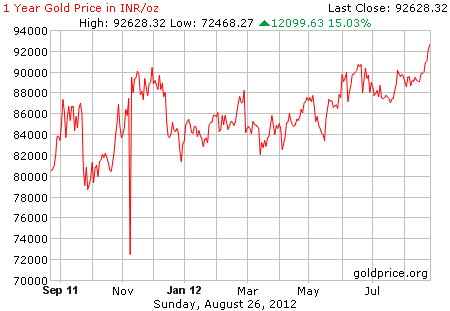
Gold hits all time high in Indian Rupees

Original source
NEW DELHI: Scaling a new peak, gold prices on Monday touched all time record of Rs 31,400 per 10 grams in the bullion market here on strong cues from global markets.
Traders said gold registered gains for the seventh trading session in a row, rising by Rs 100, on sustained buying by stockists amid rally in overseas market.
The investors were also seen shifting funds from melting equities to firming bullion, they added.
Gold Set for Best Year Since 2010
 From Bloomberg.com
Original source
Gold is poised to climb the most in two years as prospects for additional economic stimulus by governments from the U.S. to China stoke demand for the precious metal as a bet against inflation, a survey showed.
Bullion for immediate delivery may reach $1,800 an ounce by the year-end, extending gains this year to 15 percent, according to the median forecast in the Bloomberg survey of 15 traders and analysts at a conference in Hyderabad in South India on Aug. 25. That would be the most since a 30 percent surge in 2010, data compiled by Bloomberg show.
Gold is set for a 12th year of gains as the European sovereign-debt crisis boosts haven demand amid speculation of further policy easing by central banks, including the U.S. Federal Reserve, which may be considering a third round of so- called quantitative easing, or QE3. Investment holdings have expanded to a record on demand for a hedge against inflation.
Read more
Subscribe to:
Posts (Atom)